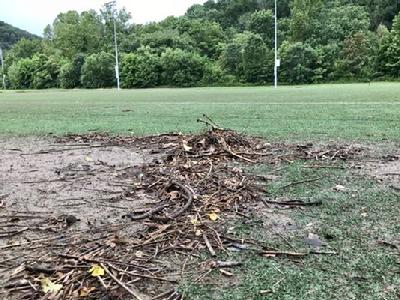
[No. 26] Ashville, North Carolina – Sub-tropical storm Alberto gets the better of Ashville’s artificial turf fields. August 2018.
[No. 25] La Cañada Flintridge, California – After all, it DOES rain in Southern California, undermining artificial turf field’s drainage! July 2018.
[No. 24] Forest City, Minnesota – Some all-weather field! July 2018.
[No. 23] Clarksburg, West Virginia: Rains and overflowing river inundate city’s artificial field. may 2018.
No. 22] Tucson, Arizona - The rains ravage Tucson High School’s artificial football field – again and again. August 2017.
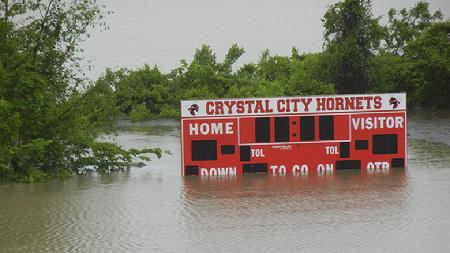
No. 21] Crystal City, Missouri – There is a limit to ‘all weather ‘ claims of the artificial turf industry. June 2017.
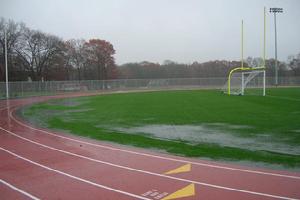
No. 20] Float that carpet; wash away the infill! October 2016.
No. 19] Newton Stewart, Scotland: Some ‘all weather’ surface! January 2015.
No. 18] East Huntington, Pennsylvania: Rains pleat the artificial turf field. September 2013.
No. 17] Bernards Township, New Jersey: Water polo anyone? June 2013.
No. 16] Bradenton, Florida: Mulch replaces artificial turf on playground. July 2012.
No. 15] Ridgewood, NJ: Flood closes down artificial turf field. April 2011.
No. 14] Ridgewood, New Jersey: The wrath of Ho-Ho-Kus devours artificial turf field. April 2011.
No. 13] Warwick, Australia: Rain damages artificial turf field. December 2010.
No. 12] Morgan Hill, California: Game on artificial turf cancelled due to rain! March 2010.
No. 11] East Greenwich, Rhode Island: Rains flood high school’s artificial turf field. November 2009.
No. 10] East Greenwich, Rhode Island: Artificial turf field floods after ½ inch of rain. July 2009.
No. 09] Dar es Salaam, Tanzania: Match cut short because turf field could not take the downpour. April 2009.
No. 08] St. John’s, NL, Canada. Turf field is damaged by the rains. December 2008.
No. 07] Lubbock, Texas: Rains flood out turf field at Texas Tech (September 2008).
No. 06] Phillipsburgh, NJ: Standing water on 30% of 2-year turf mars soccer game (September 2008).
No. 05] Stony Brook, New York: Tropical storm inundates artificial turf field (September 2008).
No. 04] Rains ruin artificial turf field at Indiana University (June 2008).
No. 03] Soggy turf in New Plymouth, New Zealand (March 2008).
No. 02] Palmerston North, Manawatu, New Zealand (December 2007).
No. 01] New Rochelle, NY (December 2007).
|
[No. 26] Ashville, North Carolina – Sub-tropical storm Alberto gets the better of Ashville’s artificial turf fields. According to a news report in the Asheville Citizen Times (23 July 2018), the flooding on 30 may 2108 due to “remnants of sub-tropical storm Alberto” damaged “the popular John B. Lewis Soccer complex in East Asheville at $968,000, a cost that will include removing silt from the turf and replacing goals and other equipment that was washed away. The complex is tucked next to the Swannanoa River, which rose to cover the four fields with an estimated 10 feet of water ….” The city will be spending $875,000 for the turf cleanup and repair at John B. Lewis Soccer Complex. “The soccer complex is built on a flood plain and has experienced occasional flooding, but the May event is the worst in the facility’s 13-year history. Source: Joel Burgess, “Flooding damage to Asheville soccer fields, recreation facilities estimated at $1.2M,” in Asheville Citizen Times, 23 July 2018, at https://www.citizen-times.com/story/news/local/2018/07/23/asheville-flood-damage-1-million-dollars-soccer-fields-recreation-facilities-azalea-park/820301002/
|
[No. 25] La Cañada Flintridge, California – After all, it DOES rain in Southern California, undermining artificial turf field’s drainage! According to a news story in The Los Angels Times (13 June 2018), “[c]onstruction crews have been busy excavating portions of the [La Cañada High School] football field to repair the artificial turf’s draining system, which officials say was adequate during drought years but not robust enough to accommodate two years of wet weather. Mark Evans, La Cañada Unified School District’s assistant superintendent of business and administrative services, said the effects of accumulated water were becoming noticeable on the surface. ‘It wasn’t draining fast enough when we had those torrents,’ he said of the system. ‘There was standing water and it was causing a kind of wrinkling effect on the field.’ Typically, rainwater percolated through the turf into a small grid of pipes underneath. Water filtered through that grid into two larger sideline drains that fed a main trunk line north of the field. From there, excess water emptied into area storm drains. Excavation will allow for replacement of the sideline conduits with larger pipes that will drain to both the north and south when the field experiences higher than average rainfall. In its June 5 meeting, the La Cañada Unified School District Governing Board approved a $185,000 contract with Signal Hill-based Asphalt, Fabric & Engineering, Inc. to complete the work before school starts in August. ‘It’s going to go on for most of the summer, but we’ll be done before school starts,’ Evans said, adding that some field use by soccer groups and football team practice will be relocated to nearby fields in the interim.” Source: Sara Cardine, “LCHS football field gets drainage upgrade after rains gang up on gridiron,” in The Los Angeles Times, 13 June 2018, at http://www.latimes.com/socal/la-canada-valley-sun/news/tn-vsl-me-field-drainage-20180613-story.html
|
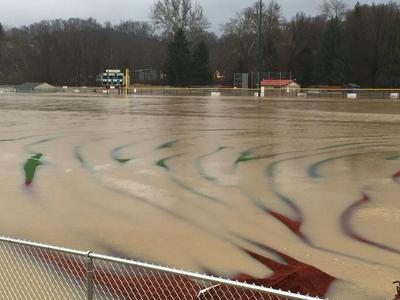 |
| “The artificial turf at Frank Loria Memorial Field was rolling up and creating a wave-like look after flooding nearby Elk Creek reached the field early Monday morning. The extent of the damage is not known as [sic] this time. Staff photo by John G. Miller.” |
|
[No. 23] Clarksburg, West Virginia: Rains and overflowing river inundate city’s artificial field. There is something to be said about not building artificial turf fields or any field for that matter in flood zones, especially near rivers and waterways. That is not only time-tested common sense engineering advice it is all the more so in the age of climate change that produces more sever weather events with greater frequency.
According to a news story in The Exponent Telegram (16 April 2018), “[h]eavy rains late Sunday into Monday morning [15-16 April 2018], pushed Elk Creek out of its banks, leading to flooding along its path, especially at Clarksburg City Park. Site of a recent artificial turf project on its main baseball field, the park's lower side, which consists of the main field, as well as five smaller baseball/softball fields and two soccer fields, is now under water. The main field, Frank Loria Memorial Field, was recently renovated with an artificial turf project costing between $550,00 to $700,000. While much of that was donated, the City of Clarksburg and Harrison County Commission did allocate funds, while the city's Board of Park Commissioners are obligated to pay back a $200,000-plus loan the city took out to complete the renovation. Now, with flooding causing apparent damage, with more likely to be discovered once the flood waters recede, Parks Director John Cooper said there will be additional costs to repair the project. ‘We discussed flooding with (the turf contractors). Depending on the extent, they said it could be $30,000 or more.’ While the full damage isn't likely to be known until later in the week, it was apparent that the water had caused the recently laid turf to roll up in spots, causing a wave-like effect. It is likely, too, that since the field surface was being pushed up, the gravel, which provides a flat base and support, has shifted underneath, which would lead to more repair work.” Source: John Mille (Executive Editor), “Flooding damages Clarksburg Park's new turf project, leaves seven fields under water,” in The Exponent Telegram, 16 April 2018, at https://www.wvnews.com/theet/news/flooding-damages-clarksburg-park-s-new-turf-project-leaves-seven/article_73b36b34-2446-5818-8c02-28adb29a5e04.html
|
[No. 22] Tucson, Arizona - The rains ravage Tucson High School’s artificial football field – again and again. 1 August 2017. As fires ravage the western fringes of the United States – in part due to the environmental fallacy of letting forests go – Tucson, Arizona, with its desert climate, is experiencing severe flash floods. Tucson, however, is no stranger to flash floods The monsoon season here occurs between mid-June to late July, typically continuing through August and sometimes into September; the intense thunderstorms and rainfall cause flash floods. But nothing like this year. Ask the folks in charge of the High School’s football field what the rains have done to it this season, giving us proof once again that Nature has a longer memory and a sterner sense of justice, to paraphrase Wendell Berry.
According to a news report in Tucson News Now (21 July 2017) “[t]he field flooded twice last week, Sunday [July 9] and Wednesday [July 12] but what caused it is still not known. According to Gloria Ellison who has owned a home next door to the high school since 1960, it’s a first. ‘The street would get flooded but never have we had that,’ she said. Pima County paid for, and the Army Corps of Engineers engineered, a $5 million drainage project that was completed last year. The project was supposed to keep 4th Avenue from flooding and the Modern Streetcar running, but both had issues. The streets flooded and the streetcar was shut down when the 4th Avenue underpass filled with water. The artificial turf football field may have suffered irreparable damage.
‘Something has changed down there,’ said District 5 Pima County Supervisor Richard Elias. ‘I think we need to figure out what happened and why and figure out whose responsibility it is.’ Elias does not believe the drainage project contributed to the flooding of the field but it never flooded before the project. ‘It's stormwater and it’s unpredictable,’ he said.” According to the report, dated 21 July 2017, “[t]alks have begun to determine how to prevent the Tucson High School Football field and track from flooding again.” Source: Bud Foster, “Preventing Tucson High School football field from flooding again,” in Tucson News Now, 21 July 2017, at http://www.tucsonnewsnow.com/story/35944541/preventing-tucson-high-school-football-field-from-flooding-again .
According to a news report on KGUN (TV 9 - ABC affiliate) in Tucson (28 July 2017), “[t]he Tucson High Magnet School football field was flooded by nearly a foot of water after last week’s storm. The storm Friday late afternoon [21 July 2017] caused more flooding. Pima County Regional Flood Control District recently completed an assessment of the damage. What they found was the grates near the football stadium were blocked with debris they believe that washed in from the street causing flooding. They also stated in their assessment that since the field has artificial turf, it has a rubberized base providing little infiltration during a heavy rain. The county administrator states in a memo that the storm drains, ‘operated effectively and significantly reduced the flood damage to the field.’ Stephanie Boe with TUSD says the district is assessing the field condition as well. The district doesn't know the severity of the damage or have a timeline for repairs. As of right now, the field is closed. The football teams are practicing at Cherry Field, and their first home game is scheduled for August 25th.” Source: Priscilla Casper, “Tucson High Football Field flooded again,” on KGUN (TV 9 - ABC affiliate) in Tucson, 28 July 2017, at http://www.kgun9.com/news/local-news/tucson-high-football-field-flooded-again
|
[No. 21] Crystal City, Missouri – There is a limit to ‘all weather ‘ claims of the artificial turf industry. According to a news story in the Leader (4 May 2017), “[f]loodwater has put the Crystal City High School artificial turf football field underwater again, for perhaps the eighth time since the turf was installed in 2008. However, dealing with the aftermath of current flooding should not be as difficult as the last time the field went under, during the historic flood of late December 2015, Crystal City High athletic director Ken Jones said. It cost about $600,000 for that cleanup (with the school district paying only a $1,000 deductible), officials said. But the field at J.J. Commerford Stadium had to be entirely replaced. ‘This time, it’s just going to be a cleanup,’ Jones said today (May 4). ‘The reason it was so much last time was the turf was 10 years old and needed to be replaced. This time it will only need a cleanup. We won’t know until we can get down there and see it. We may even be able to do it in-house.’ After the 2015 flood, district officials estimated the artificial turf field, which cost $460,000 to install, had flooded six or seven times since its installation. Jones said the latest flood came up over the field sometime Tuesday (May 2).” Source: Kevin Carbery, “Crystal City High football field submerged AGAIN,” in the Leader, May 4, 2017, at http://www.myleaderpaper.com/news/crystal-city-high-football-field-submerged-again/article_346d26d2-3114-11e7-beed-d798e52b4e13.html .
|
 |
| Photo credit: Bob Niedbala/Observer-Reporter |
|
[No. 21] Waynesburg, Pennsylvania – Inundated by the overflowing of Ten Mile Creek, Waynesburg University’s football field at Wiley Stadium is slated for replacement. According to a news item in the Observer reporter (20 December 2016), “[t]he rushing water from Sunday morning’s flood [18 December 2016] in Greene County severely damaged the artificial turf at Waynesburg University’s football field, meaning the field surface will most likely need to be replaced before the start of next season. About four or five feet of muddy water overflowing from nearby Ten Mile Creek covered the field surface at Wiley Stadium, causing the turf to buckle and wrinkle in spots and leaving a thick layer of silt across the facility, according to Heidi Szuminsky, vice president for institutional advancement and university relations.” According to Szuminsky ‘the field turf is buckled; there are places that are bubbled up and wrinkled, so we’re pretty sure we’ll need to replace it,’ and “it’s expected to cost about $500,000 to replace the artificial turf, although she did not know if insurance would cover the cost of the repairs….” Source: Mike Jo0nes, “Flood damages Waynesburg U. football field,” in Observer Reporter, 20 December 2016, at http://www.observer-reporter.com/20161220/flood_damages_waynesburg_u_football_field .
|
[No. 20] Float that carpet; wash away the infill! Guive Mirfendereski, SynTurf.org, Newton, Massachusetts. 1 October 2016. Many years ago the wunderkind of my city’s town council exhorted his colleagues to vote for the artificial turf project at one of the high schools. He had seen it with his own two eyes that just an hour after torrential rains in New York City one evening his brother’s team took to the field and played on a surface undaunted by the volume of rain that had fallen earlier.
There is no doubt, that rainfall passes through a well constructed artificial turf field like #&*% through a goose! The purveyors of artificial turf field systems make a selling point of the product’s permeability and drainage characteristics/capacity. For example, FieldTurf claims that its ‘Revolution’ field drains at 40 inches per hour. See specs for ‘Revolution’ here. There is also a video showing the impressive drainage versatility of the product at https://www.youtube.com/watch?v=bi-DsktHwkE .
So what is one to conclude when an artificial turf field does not drain as it is supposed to? There can be a problem with high water tables that do not allow for further absorption of the water that is supposed to seep into the ground? There maybe issues with the permeability of the surface due to compaction or with the underlay membrane in the substrate? There could be as mundane an issue as the clogging of the piping system that conducts the rain from the field’s containment pool to the points of discharge -- into sewers, swales or municipal drains? I would like to think that there is also Nature’s way to say hubris has a limit and the limit should be experienced often enough to remind us all – in words from Wendell Berry – that Nature has a sterner sense of justice than we do.
The FieldTurf at Xavier University (Cincinnati, Ohio) was installed in 2012. According to the news report on Cinncinati.com (23 September 2016), the “100-year storm” on 28 August 2016 that damaged the field at Xavier Soccer Complex – with a 40 inch/hour drainage capability – was only 4.4 inches. According to the report, “after a recent evaluation, the university says the surface needs to be replaced…. Test results came in late this week and confirmed the need for a complete overhaul. Source: Shannon Russell, “Big storm means new field for Xavier soccer,” on Cincinnati.com, 23 September 2016, at http://www.cincinnati.com/story/sports/college/xavier/xaviersports/2016/09/23/big-storm-means-new-field-xavier-soccer/90927340/ .
|
 |
| Spring Lake Park AD Matt St. Martin figures that the field drainage system couldn't keep up with the heavy rain, and with pumps pushing back against the deluge air was forced underneath the turf, causing the huge bubbles to form. (Photo: KARE) |
|
Farther afield, in Spring Lake Park, Minnesota, according to a news report on KARE (NBC affiliate in Minneapolis/St. Paul) (22 September 2016), the Spring Lake Park’s high school athletics director Matt St. Martin could not believe his eyes on 22 September – “The football/soccer field was under at least half a foot of water, with a large air bubble pushing the turf up in a long bump that ran down the middle of the playing surface.” According to the report, “[t]he AD figures that the field drainage system couldn’t keep up with the heavy rain that fell Thursday night, and with the pumps pushing back against the deluge air was forced underneath the turf, causing the huge bubbles to form …. The district’s maintenance crew is working with city public works personnel to pump water off the field and into city sewers. At that point, they will work with Field Turf Inc., the manufacturer of the school’s playing surface, to re-lay the turf correctly, groom and fill it with the material that makes the turf soft and playable.” Source: Dana Thiede, “Deluge does a number on SLP sports turf,” on KARE (NBC affiliate in Minneapolis/St. Paul, Minnesota), 22 September 2016, at http://www.kare11.com/weather/deluge-does-a-number-on-slp-sports-turf/323923814 .
|
Down in Smithville, Missouri, according to a news report in The Smithville Herald (28 September 2016), the “torrential downpour that flooded Smithville High School’s stadium [2 September 2016] has led to the realization that it’s time to start planning to replace the 9-year-old artificial turf.” According to the report, [t]he field may have dried out quickly, but … [t]hat Friday’s home football game [2 September] was postponed until the next morning as more than 5 inches of rain poured down on the city in less than two hours. That Saturday, when it was time for kickoff, the field was ready for action, despite students literally swimming in the end zone 15 hours earlier. But below the surface, much of which is comprised of rubber in-fill, things had shifted a bit. ‘All the water down there floated a lot of the in-fill, and it actually — the drains are out on the sides,’ Assistant Superintendent for Support Services Wayne Krueger said. ‘As the water dissipated, it took the in-fill out to the sides of the field.’ …. Krueger said the fibers of the turf playing surface were wearing out and not holding in enough rubber. ‘Without those fibers, the rubber would kind of be free-floating,’ he said, likening the in-fill to a ball pit at the play area at a fast-food restaurant. ‘What the grass fibers do is keep that rubber from doing that, and over time those grass fibers, those synthetic fibers have deteriorated.’ … [A]
company was hired to inspect the field Thursday [22 September 2016], and test its G-max rating, or its ability to absorb impact. Results from that inspection were not available at press time.” Source: Amy Neal, “Heavy rain highlight age of field turf,” in The Smithville Herald, 28 September 2016, at http://www.smithvilleherald.com/schools/heavy-rain-highlight-age-of-field-turf/article_ad5dd88a-26bf-5fa2-932b-22925bc1544d.html .
SynTurf.org Note: There is general agreement that global warming and climate change portend severe weather events even if not with greater frequency, for the foreseeable future it may well become common for events to outmatch the artificial turf’s drainage capacity.
|
[No. 19] Newton Stewart, Scotland: Some ‘all weather’ surface! According to a news report in The Galloway Gazette (30 November 2014), “[f]ootball officials were left high and dry last weekend after an ‘all weather’ £500,000 3G pitch became so waterlogged it was unplayable. Ironically, the new surface at Blairmount Park in Newton Stewart was installed after local clubs lobbied Dumfries and Galloway Council for years to get an all-weather surface in place. The 3G pitch was installed last summer to end the frustration of clubs frequently having to cancel ties on the old grass pitch which was often more mud than grass during the winter.” According to Newton Stewart FC spokesman Andy McClymont “with all the rain that fell on Friday night [28 November] the pitch had reached saturation point…. What I think is happening is the two inch layer of rubber chipping that is one of the layers under the pitch is needing to be agitated. It sits below the surface under a four inch layer of silver sand and that is all on top of a shock pad to give the pitch ‘bounce’ then below that is penetrable tarmacadam and at the bottom lies a foot and a half of hardcore. As the rubber chips layer is two inches deep, if there is two inches of rain it can cope but if there is four inches of rain, the water is coming up to the level of the synthetic grass.” A spokesman for the owners of the pitch, Dumfries and Galloway Council, said: “Council Officers are aware of the recent flooding issue at Blairmount Synthetic Grass Pitch and are working closely with Newton Stewart Football Club and the contractors to determine the root cause.” Source: “Waterlogged!,” in The Galloway Gazette, 30 N0vember 2014, at http://www.gallowaygazette.co.uk/news/local-headlines/waterlogged-1-3619343 (emphasis supplied by SynTurf.org).
|
 |
| Source: http://msn.foxsports.com/collegefootball/story/high-school-football-field-with-artificial-surface-destroyed-083013 |
|
| [No. 18] East Huntington, Pennsylvania: Rains pleat the artificial turf field. Alverton is a small rural village in East Huntington Township in southwestern Pennsylvania. It is the site of the Russ Grimm field at the Southmoreland High School. The field is ProGrass artificial turf, which was installed in 2006. According to news report on FoxSport.com (31 August 2013), on Friday, 23 August, the Township received two inches of rain in single hour. The water “burrowed under … [the] playing surface. The surface then buckled up, ripped apart and washed away. The long and short of it is that nobody knows what to do.” “Ironically, the Scotties are still able to practice, because there’s a grass practice field right next to the other one.” Source: Tully, Corcoran,“High school football field destroyed,” on FoxSports.com, 31 August 2013, at http://msn.foxsports.com/collegefootball/story/high-school-football-field-with-artificial-surface-destroyed-083013 .
|
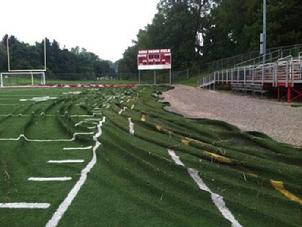 |
| Source: Cameron Smith, “You won’t believe what one hour of rain did to a Pittsburgh turf field." http://sports.yahoo.com/blogs/highschool-prep-rally/won-t-believe-one-hour-rain-did-pittsburgh-121148615.html . 30 August 2013. “School districts install turf fields to try and protect surfaces from the natural elements. Evidently that logic sometimes backfires." |
|
|
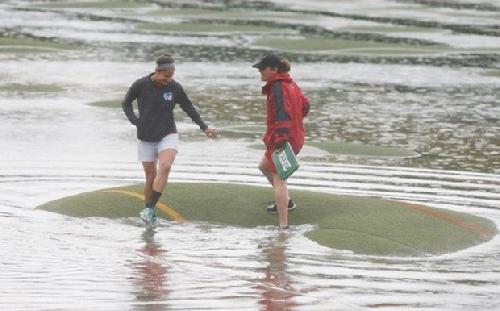 |
| Amanda Toke of Voorhees and Kat Holley in red of Morristown are surrounded by water as a storm dumped heavy rain on the lacrosse field at Ridge High School. The storm forced the postponement of the girls lacrosse match between Ridge and IHA in Basking Ridge. (William Perlman/The Star-Ledger). http://photos.nj.com/4504/gallery/heavy_rain_pounds_nj_-_may_23/index.html#/9 . |
|
[No. 17] Bernards Township, New Jersey: Water polo anyone? The following speaks for itself. Source: “Heavy rain pounds NJ, on - May 23 [2013],” on NewJersey.com at http://s.nj.com/WHyPCua .
|
[No. 16] Bradenton, Florida: Mulch replaces artificial turf on playground. 22 July 2012. According to a news item in Bradenton Herald (3 July 2012), the Lakewood Ranch staff worked to have parts of Adventure Park, a recreational area in the Greenbrook village, repaired from the damage caused by the by tropical storm “Debby” in last days of June. “The playground area of the park sustained damage when it was covered in standing water by heavy rains …. Artificial turf underneath the playground equipment had to be removed and staff [replaced] it with playground certified mulch. The cost to repair the turf under the equipment [was] estimated at roughly $5,000. Greenbrook received 12.5 inches of rain during the storm, according to Lakewood Ranch staff, and flooding increased erosion and caused turf loss in the park's trail system.” Source: Nick Williams, “Battered Lakewood Ranch park may reopen soon,” in Bradenton Heralnd, 3 July 2012, at http://www.bradenton.com/2012/07/03/4101225/lakewood-ranch-staff-hope-to-have.html .
|
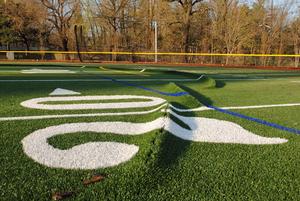
[No. 16] North Collins Village, New York: Flooding woes blamed on artificial turf field. According to a news report on MetroWNY.com (6 October 2011), on October 4, the North Collins Village Board heard an earful of complaints by residents whose property along Harrison Avenue and beyond have been subjected to ever increasing instances of flooding. “Specifically they claim that the situation has gotten worse since an artificial turf field was installed at the high school three years ago. Scott Dexter, one of those residents, … noted that the environmental impact statement the school completed states that there would be impact on drainage from the project, but without giving any details or plans for remediation. Dexter estimates he has lost at least $7,000 in possessions due to the regular flooding of his basement and property over the years, not to mention that he believes the value of his house has been severely depreciated.” “Gary Wentland noted that twice in the past three years, his swimming pool was flooded, an event that had not happened in the 44 years he had lived there. The only difference was the installation of the athletic field. He estimates his losses from flooding at $20,000.” “Village Trustee Paul Lawton II recounted his participation on the school construction committee and his concerns about drainage from the project. As the project was nearing completion and the proposed drainage improvements were not made, he raised the issue. After that, he said, he was not invited to any more meetings.” Source: Larry Wroblewski, “Athletic field blamed for flooding woes” on MetroWNY.com, 6 October 2011, available at http://www.metrowny.com/news/974-Athletic_field_blamed_for_flooding_woes.html
|
 |
| Credit: Lucy Rieger |
|
[No. 15] Ridgewood, NJ: Flood closes down artificial turf field. According to a news report on Ridgewood Patch (April 17, 2011), “High waters from Saturday [April 16] night into early Sunday morning could spell second act of the controversy dubbed 'Flood Gate'.” “Heavy rains and subsequent flooding on Saturday proves to be an eerie reminder of the March storms that dropped a $31,000 bill on taxpayers. Water was receding by early morning Sunday, leaving games canceled and muck, puckered turf, water, fish and debris at the newly-turfed high school sports fields and other village fields. The district does not yet know the cost of cleanup while a village official said work will be done in-house to clear its fields, without overtime costs.” “The flood gauge maintained by the Army Corps of Engineers details the considerable flooding in Ridgewood's '100-year flood plain' from this weekend–the brook's flood level of 3 feet exceeded 4.8 feet within roughly three hours before receding early Sunday morning. For a sense of perspective, it's slightly greater than the level of flooding on March 11, where six-plus inches of rain and melted snow stormed the flood plain. The turf fields were treated with chemicals due to concerns over sewage water flowing from the Waldwick-stationed wastewater treatment plant last go around (contamination levels were fine, however). Neighbors of the high school fields complained of the cost, $21,800 to taxpayers, and questioned the wisdom of laying down expensive turf in a flood plain. The turf fields were treated with chemicals due to concerns over sewage water flowing from the Waldwick-stationed wastewater treatment plant last go around (contamination levels were fine, however). Neighbors of the high school fields complained of the cost, $21,800 to taxpayers, and questioned the wisdom of laying down expensive turf in a flood plain.” For more on this story, please go to James Kleimann, “Fields Closed After Flood; District's Cleanup Costs Not Yet Known,” on Ridgewood Patch, April 17, 2011, available at http://ridgewood.patch.com/articles/big-floods-again-damage-fields#photo-5686086 .
|
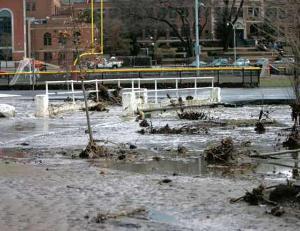 |
| Photo credit to Rich Formicola. Caption: Last week’s heavy rainfall led to flooding at village and district fields, including Stevens Field, where turf was installed last year. |
|
[No. 14] Ridgewood, New Jersey: The wrath of Ho-Ho-Kus devours artificial turf field. According to a news report in The Ridgewood News (March 17, 2011) consecutive days of rain during the weekend of March 11-13 caused the Ho-Ho-Kus Brook to flood and send “debris, silt and water - possibly contaminated from sewage plant output - surging across the village and school sporting grounds, including the Stevens Field on North Irving Street. “The Ridgewood school district is spending up to $30,000 to clean its two artificial turf fields at Ridgewood High School (RHS), as well as to treat the fields for contamination, according to Assistant Superintendent for Business Angelo DeSimone. The village is spending about $9,500 to clean up its turf field at Maple Park, said Tim Cronin, the director of the Parks and Shade Tree Division. All four major fields within flooding area of the brook, including the school's Stadium and Stevens fields, and the village's Veterans and Maple fields, have been closed until further notice.” For more on this story, see Kelly Ebbels, “Ridgewood sports fields flooded from swollen Ho-Ho-Kus Brook,” in The Ridgewood News, March 17, 2011, available at http://www.northjersey.com/news/education/118182419_Ridgewood_sports_fields_contaminated_by_flooding_from_Ho-Ho-Kus_Brook.html .
|
[No. 13] Warwick, Australia: Rain damages artificial turf field. According to a news item in Warwick Daily News (December 30, 2010), “IT took 10 men and two weeks to lay $300,000 worth of synthetic turf, and only a couple of hours of surging water [on Monday December 27, 2010] to rip it up one year later.” For more on this story, go to
Eloise Handley, “Rain damages turf,” in Warwick Daily News, December 30, 2010, available at http://www.warwickdailynews.com.au/story/2010/12/30/dreams-washed-away-hockey-warwick-association/ .
|
 |
| Photo by Laura Schraf |
|
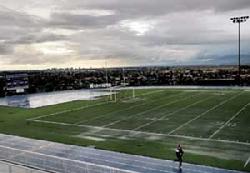
[No. 12] Morgan Hill, California: Game on artificial turf cancelled due to rain! On Wednesday 3, 2010, Lady Acrons of Love Oak High School was to take on the Santa Cruz team in Central Coast Section semifinal. The game was cancelled due to standing water on the field at Valley Christian High’s artificial turf field [photo]. A disappointed Tony Vasquez, the coach of the Lady Acons, wondered, “How do you rain out a game on [artificial] turf anyway?,” according to a news story in the Morgan Hill Times (March 5, 2010). “This week’s rainfall in the South Valley wasn’t exactly a monsoon, but it was enough to postpone the Division III girls soccer match and several other marquee games.” Source: “Forecasts further burden city budget,” in Morgan Hill Times, March 5, 2010, available at http://www.morganhilltimes.com/sports/263684-rain-washes-out-key-prep-games .
|
[No. 11] East Greenwich, Rhode Island: Rains flood high school’s artificial turf field. According to a news report on My02818.com (November 17, 2009), “The new turf field at East Greenwich High School was flooded again this weekend [14-15 November 2009] after heavy rains on Saturday.” For more of this story, go to Elizabeth F. McNamara, “School Committee To Address Fields Project Change Orders,” on My02818.com November 17, 2009, available at http://www.my02818.com/articles/2009/11/17/schools/doc4b027e479c22b517097581.txt
|
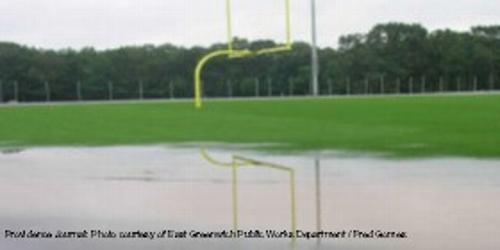 |
| Providence Journal: Photo courtesy of East Greenwich Public Works Department / Fred Gomes |
|
[No. 10] East Greenwich, Rhode Island: Artificial turf field floods after ½ inch of rain. According to a news report in the Providence Journal (July 29, 2009), “Three episodes of heavy rain this month led to flooding on part of the nearly complete football-track field at the [East Greenwich] high school, and the contractor is working on a plan to fix it.” Here is the rest of the story from the mouth of the people who did the reporting and the talking:
Public Works Director Joseph C. Duarte said the drainage problem is mostly at the perimeter of the football field, which is covered with artificial turf, and the adjacent track.
After the half-inch rainstorm you could measure water 10 feet into the field,” he said. “If my son were to play on that, I would be concerned.”
“It wasn’t acceptable,” said Ernie DiSaia, who is coordinating construction of the field for the School Department.
He said the contractors have agreed to pay for an additional drainage system around the perimeter of the field to solve the problem.
It is not known if the water is pooling because of the design of the project, the ground beneath the turf, or the turf itself, which is supposed to be porous enough to drain more than 1½ inches of water per minute.
“That’s the sales pitch of the turf people — that these fields are playable 24-7, 365 days a year,” Duarte said Monday night after briefing the Town Council on the problem.
The council has the ultimate authority over the project, but the School Committee is coordinating this portion of the field construction.
Duarte said the first time he saw the drainage problem was July 1, after a big storm. At the time, the flooding was dismissed by the contractors because installation of the artificial turf was not complete.
That explanation no longer holds water, he said, because a second round of flooding came after only a half-inch of rain on July 21, when the installation was finished. “A half-inch of rain in 24 hours is not a lot of rain,” he said.
More flooding was seen again after a rainstorm overnight on Thursday. “The middle of the field was so soggy, I had to change my shoes,” said Planning Director Lee R. Whitaker.
One solution that was contemplated was to poke holes in the artificial turf to improve the drainage.
“But that’s like punching holes in this carpet,” Duarte said. “How long is the fabric going to hold its integrity?”
DiSaia, interviewed Tuesday, agreed. “You almost make Swiss cheese out of it. You don’t want to do that.”
He said he sat down with the consultants; the contractor, Fleet Construction Co. of Cumberland, and the area representative of artificial turf manufacturer, Fieldturf, “and I said I would like to see a complete drainage system put around the field so I won’t have this problem again.”
DiSaia said peeling back the edges of the field and doing further work to eliminate the risk of flooding is going to cost “a big bundle of money,” but he has told the representatives, “I’m not going to pay for it.”
“I think they all agreed that this is the best way to do it,” he said.
Whatever the solution, “it’s not going to be a quick fix,” predicted Councilman Henry V. Boezi, a former public works director for the town, during Monday night’s meeting.
Council President Michael B. Isaacs urged the group to give the issue time to be resolved. “It’s too early to know if it’s a real problem,” he said.
But Councilman Richard P. Buonauito said the matter should be tackled sooner rather than later. “Now is the time to get the solution.”
The drainage issue is the second major problem to crop up in connection with the fields.
The first, ironically, involved not having enough water to properly irrigate the grass on the other fields.
Construction began before consulting the Department of Environmental Management, which ultimately prohibited use of an on-site well from mid-May to mid-October.
That problem was resolved with the decision — expected to cost an extra $40,000 per year — to buy the water from the Kent County Water Authority.
Source: C. Eugene Emery Jr., “Rain takes toll on new football-track field at East Greenwich High School,” in Providence Journal, July 29, 2009, available at http://www.projo.com/education/content/EAST_GREENWICH_FIELDS_07-29-09_GHF74OF_v11.353f919.html .
|
[No. 09] Dar es Salaam, Tanzania: Match cut short because turf field could not take the downpour. According to a news story in This Day (April 2, 2009), the game between Simba and Azam on Wednesday April 1, 2009, was just going just swimmingly until the end of the first half. Then during the breather (half-time) that “caused swamps of water on the artificial turf and some fans volunteered to sponge the water off the turf to no avail.” The game was called off. Source: Jimmy Tara, “Rain abandons Simba match” in This Day (April 2, 2009), available at http://www.thisday.co.tz/Sports/5538.html
|
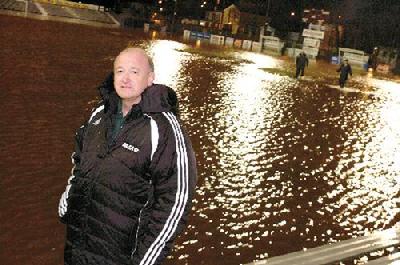
[No. 08] St. John’s, NL, Canada. Turf field is damaged by the rains. The picture on the left, by Joe Gibbons of The Telegram, shows Newfoundland Soccer Association president Doug Redmond standing in front of the flooded artificial field at the King George V Park in St. John's on Saturday night November 29, 2008. According to the caption under it: “Heavy rain Saturday did significant damage to the facility's synthetic surface. By Sunday morning, most of the water had drained from the field, only to reveal huge bubbles where the FieldTurf surface had been raised.” For more on this story, go to Robin Short, “The pitch became a pool in just two hours: King George V Park damaged by Saturday's deluge,” in The Telegram, December 1, 2008, available at http://www.thetelegram.com/index.cfm?sid=195618&sc=83.
|
 |
| Photo: TTU's Redraiders.com |
|
|
[No. 07] Lubbock, Texas: Rains flood out turf field at Texas Tech. SynTurf.org, Newton, Mass. September 26, 2008. Sometimes listening to proponents, promoters and purveyors of artificial turf fields one gets the impression that the story in of Noah may have turned out differently had the Good Lord had the wisdom of creating a planet covered wit artificial turf on top of a hyper-drainage system like the one under the turf field at Texas Tech University’s Jones AT&T Stadium. That field is Field Turf and it was installed in 2006. See http://www.myfoxlubbock.com/myfox/pages/News/Detail?contentId=7421874&version=3&locale=EN-US&layoutCode=TSTY&pageId=3.2.1 (Item No. 41).
By the time the rains on Wednesday-Thursday, September 10-11, 2008, were done, on Friday morning the turf field at Texas Tech University had turned into Lake Jones AT&T! So much for the permeability of artificial turf surfaces and their super-absorbent qualities! To quote Wendell Berry, “Whether we and our politicians know it or not, Nature is party to all our deals and decisions, and she has more votes, a longer memory, and a sterner sense of justice than we do.”
According to a news story on FOX TV 34 (Lubbock), September 12, 2008, “The stadium's pumping system was overwhelmed by the task of removing at least six inches of standing water covering the field,” so fire trucks were called in to siphon off the water.
Source: “Jones Stadium Filed Filled With Water, on Fox TV 34, September 12, 2008, available at http://www.myfoxlubbock.com/myfox/pages/News/Detail?contentId=7421874&version=3&locale=EN-US&layoutCode=TSTY&pageId=3.2.1 .
According to a news story in the Lubbock Avalanche-Journal (September 13, 2008), At about 10:30 A.M. there were 2 feet standing water at the edge of the turf field, amounting to a total of 800,000 gallons of accumulated water. A 15-member contingent and two fire trucks worked for five hours to suck approximately 300,000 gallons of water from the Jones AT&T Stadium into the city’s drainage system, which end up eventually in Yellowhouse Canyon. In the meantime, Tech employees set to “repair a flooded drainage system that usually keeps the playing surface dry.” The Journal also reported that “Contending with excess water at Jones is nothing new. When the stadium was renovated in the late 50s, underground water regularly flooded the field, so officials installed a three-pump system to keep the surface dry.” But “[t]he usually reliable pumps were no match for the non-stop, tropical rains that dumped nearly eight inches of water in some Lubbock spots.” Source: Don Williams, “Game on! Firefighters help drain gallons of water at Jones field,” in Lubbock Avalanche-Journal, September 13, 2008, available at http://www.redraiders.com/?p=1929 .
|
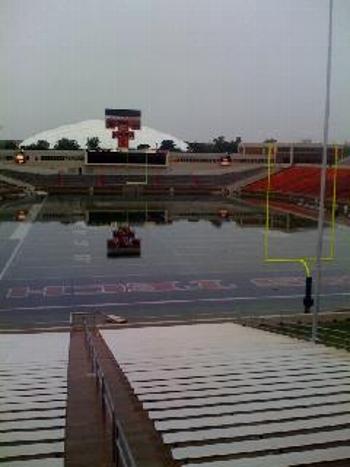 |
| Photo: FOX TV 34 - Lubbock |
|
|
|
|
[No. 06] Phillipsburgh, NJ: Standing water on 30% of a 2-year old turf field mars soccer game. On Friday, September 12, 2008, Voorhees High School (New Jersey) squared off against Phillipsburg High School (New Jersey) for the opening game of the Skyland Conference Delaware West Division soccer season. According to a report in The Express Time (September 13, 2008), the teams splashed around on Phillipsburgh’s artificial turf field to a scoreless tie. “The game was played in a steady and sometime hard drizzle on a synthetic field that either doesn’t drain properly or just couldn’t handle the load.” Neither side saw any redeeming value in the game. The Voorhees coach, Joe Tucker, “saw nothing but rain drops and puddles on the field.” “This is a turf field and there is standing water on 30 percent of the field,” Tucker said after the game. The water-logged field slowed the pace of the game to a point that the first shot on goal came 20 minutes into the game, followed by the second one 12 minutes into the second half. “By the end of regulation most ground passes stopped dead in their track,” according to the Express. Source: Tom Mugavero, “Rain puts damper on opening day,” in The Express Time, September 13, 2008, available at
http://www.lehighvalleylive.com/sports/index.ssf?/base/sports-0/1221278740249370.xml&coll=3 .
SynTurf.org Note: The Phillipsburgh High School’s soccer field is by FieldTurf and was installed in April 2006. See, http://www.fieldturf.com/lacrosse/installations.cfm?keyword=&state=New+Jersey&country=all&year=all&sport=all&resultCount=all&sortOrder=installDate+DESC%2C+installID+DESC&formSubmit=yes (Item No. 110).
|
[No. 05] Stony Brook, New York: Tropical storm inundates artificial turf field. Stony Brook University on Long Island is the home of the Seawolves football team. On September 6, 2008, as the remnant of Hurricane Hanna was pouring a few inches of rain on the New York City area, the Seawolves played host to the Elon University’s Phoenix, from North Carolina. The visitors won in a contest that normally would not attract this site’s attention but for the poor performance of the artificial turf that covers the pitch at Stony Brook’s Kenneth P. LaValle Stadium. The venue opened in 2002. According to a report in News Day (New York), a touchdown by Stony Brook’s Eddie Gowins “was a puddle jumper in near ankle-deep water.” “Gowins rushed 11 times for 122 yards, 72 of those coming on a lake-like artificial turf with 9:31 left in the third quarter.” “It's football, you have to play in rain, snow, sleet, hail,” a good-natured Gowins said. Source: Steven Marcus, “Elon 30, Stony Brook 20: Gowins shines but Seawolves get swamped,” in News Day, September 7, 2008, available at http://www.newsday.com/sports/football/ny-spstony075833038sep07,0,362303.story .
SynTurf.org Note: Daily News also quoted the sensational running back Gowins as saying, “We woke up too late. Next time we have to come out harder from the beginning.” Maybe the Phoenix should first figure ought why the 6-year old turf field flooded. This is not supposed to happen, right? Five years of compaction of the sub-base, some settling perhaps, and compacted infill could rob the field of its much ballyhooed permeability and absorbency. Broken or clogged drainage pipes or even storm water backflow could result in this sort of catastrophe.
|
[No. 04] Rains ruin Indiana University’s artificial turf field. SynTurf.org, Newton, Mass. June 8, 2008. United Press International (UPI.com) reports, “A combination of high winds and heavy rain has damaged the Indiana University football field so badly that the artificial turf may need replacement.” The university’s athletic director has told the Indianapolis Star that the replacement could cost as much as $1 million. “The field was deluged [during the week of June 1, 2008], with the wind driving the water under the carpet of artificial grass. The damage included a 10-inch sinkhole in the south end zone,” according to UPI. “Part of the turf just collapsed like one of those landslides you see in California where the foundation just goes out from under it,” according to the athletic director. The university’s football coach said the field was “an incredible sight” Thursday morning [June 5] as water drained away laving sinkholes and lumps behind,” according to UPI. Source: “Storm damages Indiana U. football field,” in UPI.com, June 7, 2008, available at http://www.upi.com/Top_News/2008/06/07/Storm_damages_Indiana_U_football_field/UPI-69941212889204/.
|
 |
| Taranaki-Wikipedia/German |
|
[No. 03] New Plymouth, Taranaki, New Zealand: Waterworks at Webster Field hockey turf. SynTurf.org, Newton, Mass. April 1, 2008.
The Taranaki Province lies on the Tasmanian Sea and it is a very scenic area of New Zealand. In the provincial center, New Plymouth, the Webster Filed houses the area’s premier hockey field. It is turf.
Recently a suspected rupture in a subsurface water pipe has caused enormous damage to the turf field, requiring as many as four months for repairs. The damage at first appeared minimal, but now there is news that the chip seal foundation of the structure may be have been destroyed. According to David Griffiths, the fields’ turf manager, the surface felt spongy when he walked on it as though the seal chip underneath the turf was broken.
Source: Matt Rilkoff, “Taranaki premier hockey turf is soggy and with it the province’s hockey season, April 1, 2008, available at http://www.stuff.co.nz/stuff/dailynews/4458961a6404.html.
This raises an interesting question in two ways: First, what is the implication of this story for fields that are constructed in areas that have hydrological issues associated with wetlands and flood control? Second, what should be done in order to eliminate the likelihood of damage to a field by a breach in the plumbing that serves the field – such as collector and conduit pipes under the turf, and sprinkler and watering systems used to clean and cool the turf fields? What does this say about a municipality that is not even capable of protecting pipes that feed a park’s water fountain from, clogging, breakage and freezing?
|
 |
| Out with the old: where to? Photo: Warwick Smith/Manawatu Standard |
|
[No.02] Plamerston North, Manawatu, New Zealnd: What in earth’s name!? SynTurf.org, Newton, Mass. December 22, 2007. Manawatu fancies itself as the gateway to New Zealnd’s culturally rich and beautiful North Island. A two-hours drive from Wellington, the region boats a combination of rural charm and sophisticated provincial appeal in an area bound by sweeping lanscapes of vallaeys and mountain ranges and coastal vistas. It is blessed with a mild climate, which provides the region with fantastic growing conditions for many of its public and private gardens. It is a perfect setting for an artifcial turf field, no?!
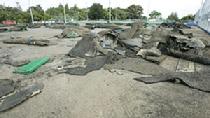
On Thursday, December 6, 2007, one truck after another removed loads and loads of the “spoiled” astroturf from Fitzherbert Park. Located on Fitzherbert Avenue in Awapuni Ward, the sportsground’s facilities include a pavillion, grandstand, hockey fields (turf) and cricket wicket.
Under the auspices of Hockey Manawatu, the hockey turf fields were installed in 2001 with a life expectancy of more than 10 years. It has been cut short because of the failure to seal the carpet properly to the base, which could have been remedied for a cost of $40,000 at the time of its discovery. The authorities chose not to spend that additional sum. And so now the facility is on the hook for the $750,000 cost of removal of the old carpet and replacement. Lucky for Hockey Manawatu, the Palmerston North City Council is the current owner of the fields and it will foot the bill on this project as the lessor. Hockey Manawatu will continue to pay for the annual maintenance of the fields, which amounts to $10-20,000.
According to Peter lamp reporting on this story, “The American company which laid the [original] turf has long gone into receivership so Hockey Manawatu had no recourse there. The new turf will be installed by another American astroturf company with the turf carpet being shipped from the United States via Australia. It is the same material used for the turfs for the Beijing Olympics.”
Source: Peter Lampp, “Reid greets Astroturf excavation with relief,” in Manawatu Standard, December 7, 2007, available at http://www.stuff.co.nz/stuff/eveningstandard/4315649a24537.html.
|
[No. 1] Flood washes out turf field in New Rochelle, NY. SynTurf.org, Newton, December 22, 2007. In mid-April 2007 a few days of rain resulted in a mudslide downhill onto the artificial turf field at New Rochelle’s Sidelsky Memorial Field, causing the turf to detach from its base in the southwest corner of the field. According to the Parks Commissioner William Zimmermann, “[r]ubber particles that are mixed with the sand were washed away.” While the city has managed to maintain the field for now, it is in shambles: Its surface has wrinkles that cannot be straightened out, according to Zimmermann. Source: Ken Valenti, Federal, state funds will replace damaged New Rochelle Field,” in The Journal News, December 19, 2007, available at http://www.thejournalnews.com/apps/pbcs.dll/article?AID=/20071219/NEWS02/712190334/1018/NEWS02.
|
|