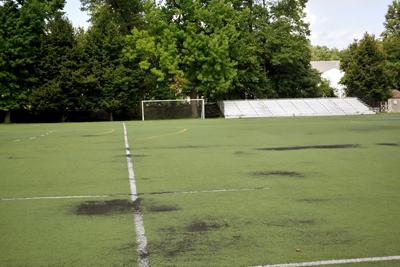
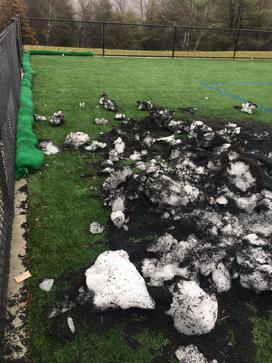
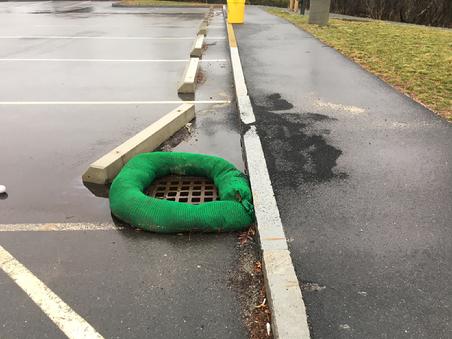
[No. 15] Montclair, New Jersey – Heavy rains wash away crumb rubber off three town fields. September 2018.
No. 14 Where do the broken plastic blades and micro plastic debris from artificial turf fields go? December 2017.
No. 13 Medway, Massachusetts – Crumb out-migration in these anti-immigrant times! May 2017.
No. 12 Somerville, Massachusetts –Premature deterioration (fraying of) artificial turf field; migration of crumb rubber and fraying plastic grass. March 2017.
No. 11 Crumb rubber off-migrates at New Era Stadium in Buffalo, New York; sand flies off the turf in Gillette Stadium in Foxboro, Mass. January 2017.
No. 10 O, where do those plastic turf fibers go? May 2016.
No. 09 Crumb rubber pellets invading players’ private spaces. July 2015.
No. 08 Allentown, Pennsylvania: Pictures of migrating crumb rubber. January 2015.
No. 07 How much crumb gets into your cleats? April 2009.
No. 06 Poughkeepsie, NY: Randy Marquis hated coming home with mouthful of rubber. August 2008.
No. 05 The traveling crumb-rubber (August 2008).
No. 04 "Seattle Fields" - migration of crumb pellets. January/April 2008
No. 03 Crumb rubber everywhere! What's a soccer mom to do? April 2008
No. 02 New Rochelle (December 2007)
No. 01 Bad Maintenance Practices at the "Y" (December 2007)
|
Editor's Note: "An Iota about Migration," November 18, 2007.
In "turf talk" the term "migration" has come to mean the movement of crumb rubber granules from the field onto areas around or off the field. The environmentalists and affected citizens are concerned about the movement of the rubber granules directly into storm and sewer drains, into rivers and other bodies of water, and seepage (as leachate) into ground and/or ground water and wells.
Perhaps pedestrian, but also an important part of the story of crumb migration is the movement of crumb granules and broken shafts of the polygrass into the home. Fresh from their sporting exploits, junior and missy bring home the crumb granules and bits of polygrass on their skin , apparel and footwear. All too that ends up in the vacuum cleaner/garbage bags, or shower/tub drain -- out of the house and into the environment, they go. But, worst of all, the most insidious form of "migration" of the materials used in artificial turf fields -- grains or particulates polygrass, crumb and silica -- in lungs and/or digestive systems of people who play on artificial turf fields.
It does not require a fertile imagination to conceive of the manner in which pieces of polygrass and crumb and silica can easily be ingested or inhaled by players.
In September 2007 SynTurf visited the artificial turf field located in the back of Fresh Pond Mall Cinema Complex, in Cambridge, Massachusetts. The field was only four years old, but it showed already signs of extreme wear and tear, no doubt due to over use (which SynTurf.org has learned is a condition that voids the turf warranty). A bear foot-walk from the sideline to the center of the field and back produced a significant amount of broken bits of polygrass attaching themselves to the bottom and side of the feet, perhaps due to skin's humidity or the static present in the polygrass. Regardless, it does not require a wayward imagination to conceive of bits of polygrass blowing in the winds that sweep or the rains that wash the fake tundra.
|
[No. 16] Vancouver, British Columbia – The Vancouver lead scare puts focus on crumb rubber migration. According to a news report on CBC (j June 2019), “[a] laboratory test revealing lead in rubber turf pellets from a Vancouver park is causing some local citizens to ask officials to remove the faux fields. A group of citizens sent samples from playing fields at Trillium Park in Vancouver's Strathcona neighbourhood to a Burnaby, B.C., environmental testing lab called Total Safety Services. They received the results last month. A sample of rubber infill contained 15.9 micrograms of lead per gram. The amount is below the allowable limit of 90 micrograms of lead per gram in surface coatings like paint, according to the Federal Canada Consumer Product Safety Act. Any amount of lead is unacceptable to Janet Brown and other advocates Peter Nicol and Marlene Cummings, who are worried about the environment and people's health.”
|
“Rubber crumb is spread across synthetic turf playing fields to help the green fibres stand upright, stabilize the surface and provide shock resistance. It doesn't always stay put though. Bits of the rubber crumb find their way to nearby shrubs and grass, as well as inside storm sewers." Source: Micki Cowan, “Group wants Vancouver to axe artificial turf fields after lab test confirms lead,” on CBC, 7 June 2019) at https://www.cbc.ca/news/canada/british-columbia/artificial-turf-lead-vancouver-1.5165863
|
[No. 15] Montclair, New Jersey – Heavy rains wash away crumb rubber off three town fields. According to news reports in Montclair Local (15 August 2018), “[t]orrential rains exasperated problems at the aging Watchung, Fortunato and Woodman fields during Monday’s [13August] storm. The synthetic turf infill was lifted due to the rains and some turf was displaced at Watchung. With football practice in full swing and various other sports gearing up for their seasons, the MHS grounds staff worked early Tuesday to groom the fields for use, raking the infill back into the synthetic turf, according to Athletic Director Patrick Scarpello…. Scarpello said the turf at Watchung has been occasionally bubbling up, when water gets trapped underneath it. That can cause some more widespread infill displacement, and Scarpello said it’s a sign there’s probably a drainage problem…. SportCare, a company which deals with the maintenance of synthetic fields, will be doing some preseason grooming on all three fields next week. ‘They’ll be grooming to mostly make things look nice and help with what the rain just did to the field,’ Scarpello said. ‘If they have to add infill to Watchung or Woodman they will, but they can’t add any more to Fortunato, because the [turf] fibers aren’t erect enough to keep the infill in and it will wash away with the first rain.’ … ‘Every six weeks, we will have SportsCare come out and do a de-agitation process, which just keeps the field nice and soft to play on,’ Scarpello said.” Source: Andrew Garda, “Montclair Athletics: Massive rainfall causes infill displacement on MHS fields,” in Montclair Local, 15 August 2018, at http://www.montclairlocal.news/wp/index.php/2018/08/15/montclair-athletics-massive-rainfall-causes-infill-displacement-on-mhs-fields/
|
[No. 14] Where do the broken plastic blades and micro plastic debris from artificial turf fields go? We already know that the crumb rubber in any size and form (granule or dust) migrates from the artificial turf fields. On this page are ample posts the discuss or provide visual evidence of migration of crumb rubber infill. The migration is not only geographical (like from the field into the car and the house) but it is also capable of ending up in a human body (ingestion, inhalation, contact) or an animal or streams and other bodies of water.
The best evidence of migration is the fact that every artificial turf needs infill replenishment every now and then; that is in order to make up for the infill lost to migration. One should be equally concerned about migration of the broken plastic filament of the carpet and other degradable parts of the artificial turf system. .” For an earlier post o this topic, see http://www.synturf.org/migration.html (Item No. 10) below. For the federal Consumer Product Safety Commission’s look at the issue, go here. For a primer on manufacturing of plastic turf, go here.
Consider the environmental and health implication of the following revelation about artificial turf degradation at Bradshaw Mountain High School’s athletic fields in Prescott Valley, Arizona. According to a news story by Sue Tones, “Possibility for new turf at high school fields - School board to decide on repairing, or replacement,” in The Daily Courier (29 November 2017), at https://www.dcourier.com/news/2017/nov/29/possibility-new-turf-high-school-fields/ , “[a]fter nine years, the artificial grass is thinning, rather like areas of pink scalp showing through a star athlete’s once lush head of hair, Bradshaw Mountain High School’s athletic fields are in need of a new ’do…. Turf blades are worn down to about half their original length. Rubber pellets used to weigh down the turf and also provide cushioning now sit on top of the turf blades in some areas causing some portions to look more gray than white."
The length of “grass blade” varies based on the expected form of use. Field hockey “grass blades’ are shorter, let’s say, than the plastic blades for soccer or football fields. The average length of plastic blades at installation is about 2 inches. Imagine now millions of the petroleum-based half-blades detached and off-migrating to other places and hosts! That may well be equal to a quantity that one could not/should not dump in the landfill if it were in the form of plastic products like milk jugs or yogurt containers. And yet the micro plastic debris is by hundreds of pounds absorbed one way or another into our environment, including in the self-righteous communities where the residents have voted to ban the use of plastic shopping bags but have no qualms about cheering their little ones playing on the half-worn plastic carpet!
|
[No. 13] Medway, Massachusetts – Crumb out-migration in these anti-immigrant times! The pictures above show the condition of an artificial turf field in Medway, Massachusetts on 6 April 2017. Yummy!
|
[No. 12] Somerville, Massachusetts –Premature deterioration (fraying of) artificial turf field; migration of crumb rubber and clumps of plastic grass. “East Somerville Community School Field Report: A report on the state of the artificial turf field at the East Somerville Community School, three years after installation.” Published by Green and Open Somerville, 23 February 2017 – on You Tube at https://www.youtube.com/watch?v=J6l617uHn80&t=8s .
|
 |
| Photo credit: Heather Prusak, WGRZ, Buffalo, NY |
|
|
[No. 11] Crumb rubber off-migrates at New Era Stadium in Buffalo, New York; sand flies off the turf in Gillette Stadium in Foxboro, Mass. SynTurf.org, Newton, Mass. 15 December 2016. This page, titled “Migration,” is dedicated to items that show or explain how infill on artificial turf fields moves off the field. The forces that effect the off-migration are provided by nature (such as wind and water) and by folks who ply the surface (such as players, personnel, visitors and, yes, the groundskeepers and their equipment).
The most dramatic pictures of off-migration of crumb rubber are obtained in connection with snow removal. Here is one example of what not to do! On Sunday, 11 December 2016, during the half-time of the contest between the visiting Pittsburgh Steelers and Buffalo Bills at New Era Stadium, in Buffalo, New York, the crew decided to plow the dusting that had carpeted the field. As the images at http://nesn.com/2016/12/steelers-vs-bills-game-delayed-by-rubber-pellets-mess-at-new-era-field-in-week-14/ and
http://www.si.com/nfl/2016/12/11/bills-steelers-delay-snow-plows-rubber-pellets show, the brush machines instead dug up thousands of pounds of crumb rubber from the turf and then the ground crew plowed mounds of the stuff by the shovelful and by leaf blowers off to the sidelines – producing a sight to behold (in horror). One must wonder if that amount of rubber removed from the field affected the G-max of the surface (of course it did!) and maybe contributed to the Bills losing ground in their quest for a playoff spot in 17 years (nah!).
An edited clip of the Buffalo Buffoonery has been uploaded on You Tube by SF Parks (13 December 2016) at https://www.youtube.com/watch?v=O__9uSzsLSo&feature=youtu.be and it is worth a look. However, the video identified the turf at New Era Stadium as AstroTurf, which is not be accurate. According to Wikipedia, the turf at New Era Stadium is A-Turf (https://en.wikipedia.org/wiki/New_Era_Field). SynTurf.org reached out to A-Turf to verify the make of the turf at the stadium as well as to ask why the ground crew would clear a little itty snow off the field with equipment that rips out all the rubber infill.
A-Turf responded in an email that the equipment the Bills used was the correct equipment. “The depth that the brushes go into the turf is determined by simple adjustments via levers that are hydraulically operated,” wrote Jim Dobmeier, President & Founder of A-Turf. The brushes can be lifted off the turf completely or go deep into the turf if as needed, or anywhere in between. “What occurred was caused by the brushes being too deep into the turf system,” he wrote. “This is the 6th year that the Bills have had this field. The equipment operators know what they are doing but made a mistake,” according to him.
If you have been watching the New England Patriots playing at home since late November you may have noticed that instead of the black rubber pellets some sandy color stuff has been flying off the field. As hope springs eternal at SynTurf.org that one day crumb rubber be eliminated from synthetic surfaces, one could not help but ponder if the Patriots had replaced the black rubber pellets with sand or perhaps the organization has chosen a sandy color rubber pellet. SynTurf.org reached out to the folks at Gillette Stadium to get an explanation of what flies off the turf at Foxboro these days! “In short,” wrote CustomerSerivce in an email, “our game field has always had a mix of crumb rubber and sand. Recently we top dressed the field with sand as part of our ongoing cultural practices which is why you saw sand and not the rubber. With weather and continued grooming this will be less noticeable at future games.” What was exactly meant by “ongoing cultural practices,” SynTurf.org queried further. “By ongoing cultural practices we meant the ongoing standard maintenance of the field,” wrote CustomerService.
|
 |
| Sports reporter Jonah Javad’s tweet takes note of crumb rubber toxicity |
|
|
 |
| CBS2 New York |
|
[No. 10] O, where do those plastic turf fibers go? Tire crumb migration from artificial turf fields grabs all the headlines. A lot less attention has been paid to the migration of the plastic turf fibers. With the aging of turf fields and some due to poor quality of the carpet itself and prevailing weather and exposure to sun rays the migration of turf fibers is expected to increase as the balding fields disgorge their polluting fibers into the environment, including into the animal digestive tracks. Yet the focus thus far regarding the deterioration of the turf fiber is dominated by talk of premature failure of under-warranty fields and replacement of them.
According to a an investigative report on CBS New York (18 April 2016), “[a]cross the country, some of those turf fields at public schools and parks are prematurely falling apart … A number of those faulty fields may be right here in our area, and taxpayers are the last to know. The soccer fields at Brentwood State Park may seem perfectly fine until you look at your shoes. The artificial turf is breaking off.” According to West Islip Soccer Club President Gary Koffsky “It’s on people’s clothes, on their cleats, it’s covered in it.” According to a turf consultant, “It frays, and then the frays break down into smaller fibers. In other words, a wide fiber would stand wear and tear. Where it breaks down to hairline fibers, those fibers break apart. They don’t have strength.” “Lists acquired by CBS2 name well over 100 fields in New York and New Jersey that likely got the flawed fibers. Source: Carolyn Gusoff, “CBS2 Exclusive Investigation: Sources Say Trouble-Plagued Turf Is In Tri-State Public Schools And Parks,” on CBS2 (New York), 18 April 2016, at http://newyork.cbslocal.com/2016/04/18/artificial-turf-investigation/ . For an article on this report, see Mike Ozanian, “Never Let This Happen To Your Town,” in Forbes SportsMoney, 19 April 2016, at http://www.forbes.com/sites/mikeozanian/2016/04/19/never-let-this-happen-to-your-town/#638972534431 -
|
[No. 09] Crumb rubber pellets invading players’ private spaces. The heating of the plastic and crumb rubber-infilled fields at the Women’s World Cup venues is due the thermodynamics of these fields—the plastic blades and crumb rubber heat up and retain heat due to their physical properties; however, because crumb rubber (with or without sand mix) also surrounds the plastic blades and acts like an insulator of heat, making the plastic blades all the more hotter. While heat has become the “story” of the games, the millions of little crumb rubber pellets are making their way into the private spaces (and parts) of the players—thus causing health concerns (exposure to the toxins and carcinogens in crumb rubber) and an environmental challenge (migration of hazardous waste). According to a news report in The New York Times (23 June 2015), “FIFA has long supported and praised developments in artificial turf technology, and it has pushed its wider use. … But questions have been raised about whether players’ repeated exposure to all that ground-up rubber comes with the risk of health problems. Much of the evidence remains anecdotal, and the studies on the topic have been limited or financed by the industry itself. Until there is more data, women’s soccer will have a World Cup to remember, black pellets and all.”
The up-close and personal nature of the contact between player and crumb rubber leads to unwanted intimacy. According to United States defender Julie Johnston, “We find those things everywhere. They are between your toes and in your shorts. Two days later, you’ll find some on another part of your body. You’re like, ‘I don’t understand how this isn’t leaving.’” “Midfielder Megan Rapinoe said that she had discovered the dark pellets in her hair and her nose, but not yet, thankfully, in her mouth. The mere mention of the topic drew a feigned look of disgust from her teammate Meghan Klingenberg.” Klingenberg said, “I’ve found them in my bra — it’s incredible where you can find them. I’ll take a shower later that day, and I’ll be like, ‘What in the world?’ ” United States midfielder Lori Chalupny has found “the pellets in her bedsheets days after playing on artificial turf.” “The Swedish midfielder Nilla Fischer said some of her teammates wrapped each of their toes with athletic tape every time they played on turf, to prevent blisters created by the scorching surface. And when those players remove the tape, what do they find collected on it? You guessed it: more souvenir pellets.” “Chalupny said she felt terrible every time she changed in her hotel after a game or a practice, knowing that the simple act of peeling off her shorts and shirt would send the traveling tidbits in every direction — onto the carpet, into the tub, onto furniture.” “I’m sure the maids just love us,” Chalupny told The New York Times. According to the Times “[b]ut one maid at a team hotel here couldn’t tell me how much of a nuisance the pellets might have been at this World Cup, or how annoying it could be to find them in the laundry days after the teams had departed. She said she was afraid to talk to a reporter. ‘I’m sorry, but I don’t think FIFA would like that… And we don’t want to get in trouble with FIFA.’” Source: Juliet Macur, “At the Women’s World Cup, a Memento Players Are Stuck With and Stuck To,” in The New York Times, 23 June 2015, at http://www.nytimes.com/2015/06/24/sports/a-memento-players-carry-with-them-like-it-or-not.html?_r=0
|
[No. 8] Allentown, Pennsylvania: Pictures of migrating crumb rubber. Between 6,000 and 7,000 pounds of crumb rubber can come out [migrate] off a field each year. See Andrew McNitt: Between 6,000 and 7,000 pounds of crumb rubber can come out [migrate] of a field each year, at http://www.synturf.org/crumbrubber.html (Item No. 34, posted June 2014). The following gallery of migrating crumb rubber infill, by Timothy Ford, appeared in Patrick Lester, “Artificial turf debate: Is it safe for children?,” in The Morning Call, 6 December 2014, at http://www.mcall.com/news/local/mc-lehigh-valley-artificial-turf-dangers-20141206-story.html#page=1 . The pictures feature Lehigh Valley artificial turf field.
|
[No. 07] How much crumb gets into your cleats? Last month we ran an item here entitled “Ouch: Those pesky crumb rubber bits that injure!” http://www.synturf.org/health.html (Item No. 26). It was about a guy who goes to try out with the Kansas City Wizards soccer team and end us with pain in the ball of his foot, which he suspected was caused by “the pellets from the synthetic grass in [his] sock that were scraping [his] foot. This week we received a communication from a company that makes a product that claims to prevent crumb rubber from ending up in your cleats. According to the “technical” information provided by it, in the course of one hour of play one can get 82 grams of crumb rubber pellets in a cleat, as they hop off the ground and roll down the cleat by way of the ankle area.
|
[No. 06] Poughkeepsie, NY: Randy Marquis hated coming home with mouthful of rubber. On August 30, 2008, the Poughkeepsie Journal quoted Kevin Marquis, owner of Competitive Edge Physical Therapy in Poughkeepsie, as saying his son, Randy, who played football at Franklin D. Roosevelt High School in Hyde Park and then Franklin & Marshall College in Lancaster, Pa., hated “coming up with a mouth full of rubber” after playing on infill turf fields. Source: Pete Colaizzo, “Athletes quicker on surfaces, but injuries are still common,” in Poughkeepsie Journal, August 30, 2008, available at http://www.poughkeepsiejournal.com/apps/pbcs.dll/article?AID=/20080830/SPORTS/808300336 .
|
[No. 05] The traveling crumb-rubber. According to the news story in the Daily Times (Florence, Alabama), these days the football players of the University of Northern Alabama are seen emptying their cleats of the crumb-rubber pellets. It is a daily routine, according to wide receiver Robbie Burdine: "I have to empty them out of my shoes every day. They get stuck on your arms, legs and in your pants. It takes a while to get all of them off of you." Source: Jeff McIntyre, “Pesky pellets pester players,” in Time Daily, August 23, 2008, available at http://www.timesdaily.com/article/20080823/NEWS/808230322/1164&title=Pesky_pellets_pester_players .
|

Seattle Fields: Migrating crumb rubber | [No. 04] More migration pictures. The selection below is from PlasticFiledsforNever.org and is entitled “Seattle Fields,” January 2008. In viewing this power-point presentation, please note the following -- First the migration of rubber pellets from the turf field at Van Asselt Elementary School and, second, the prevalence of crumb rubber pellets around sewers and drains. Click on PPT icon on the left.
|
[No. 03] Crumbs everywhere! What’s a soccer mom to do? By Guive Mirfendereski, SynTurf.org, Newton, mass. April 18, 2008.
Each artificial turf field has about 100 tons of crumb rubber granules applied loosely to the surface. Along with the sand (silica) the crumb helps with the cushy feeling of the turf and also acts as the ballast that keeps the turf all the more secure in place. In venues where best practices prevail, before each game, the field is watered down in order to weigh down the crumb and sand and to minimize dusting and, on hot days, water is used also to reduce the temperature of the field. Regardless of its nature – be it crumb rubber from used tires or other source, thermoplastics, coconut, tofu or other materials – because it is not nailed down, weighed down, glued or woven into the carpet, the granules (also called in-fill) travel off the field. We call this phenomenon “migration” and it can be induced by watering, rain, wind, footwork or other forces or dynamics.
In November 2007 SynTurf.org published a photographic mini-essay on migration of crumb rubber. See, http://www.synturf.org/migration.html.
Recently, a reader shared her frustration over crumb rubber hitching a ride back home on the body and clothing of her passengers. Joyce, who has requested partial anonymity, is a Morristown soccer mom, who often accompanies her elite-level daughters and their teammates to soccer games.
“The problem with crumb rubber wasn’t this bad in pervious years, because the girls would play on the turf maybe one or two games during the whole season,” she told SynTurf.org. “Now,” she said, “it seem like every game is being played on turf.”
In an e-mail to SynTurf.org, Joyce wrote: “These [pictures] were from one practice session [in early April 2008] on a FieldTurf field. [The] reps that testified at our local school and land use board claim[ed] that the crumb rubber is cryogenic and it does not travel. I beg to differ.”
|
“Three players in my car were complaining that the crumb rubber was sticking to their faces and skin during practice. They all said it was sticking in their hair, and they were picking it out of their hair in the car. I know from experience that it gets all over the car, in their cleats, shin guards and socks. It ends up in my mudroom, bathroom shower, laundry room floor, and washer/dryer. If I did not insist that my kids shower immediately when they get home, it would in fact get into their bedrooms and their beds.”
SynTurf.org Editor’s Note: The players who play on crumb rubber assume some degree of the risk of exposure to the toxins and other harmful substances associated with crumb rubber. The players and parents may very well be made to waive any right to complain about crumb rubber, including that it is a nuisance. However, because it migrates, crumb rubber poses also risks to persons who do not necessarily come into direct contact with the fields. This means, for example, after a game or practice, the crumb rubber rides on players and ends up in the gym, class room or locker room where other children and adults will come into contact with it. This should be particularly of concern to environments that claim to be latex-free.
The migration of crumb rubber also poses an interesting legal question. Can an action lie against a defendant who owns, operates or manufactures artificial turf fields, or against a club that hosts game/practices on turf, for the nuisance and/or trespass caused by migrating crumb rubber?
|
[No.02] New Rochelle’s April ‘flood’ washed out the crumb. SynTurf.org, Newton, December 22, 2007. In mid-April 2007 a few days of rain resulted in a mudslide downhill onto the artificial turf field at New Rochelle’s Sidelsky Memorial Field, causing the turf to detach from its base in the southwest corner of the field. According to the Parks Commissioner William Zimmermann, “[r]ubber particles that are mixed with the sand were washed away.”[1] While the city has managed to maintain the field for now, it is in shambles: Its surface has wrinkles that cannot be straightened out, according to Zimmermann.[2] The solution: to replace the field at the cost of $2 million, of which $1.5 million comes from the Federal Emergency Management Agency and the rest from the state. The project raises two questions:
(1) Where to did the flood carry the rubber particles and what steps will the city take in order to clean up the contamination caused by more than 100 tons of shredded tire granulates washed into the environment? The city’s request for proposal on the project (Specification No. 4731) does not seem to indicate any discussion of clean up of the site. The RFP is available here.
(2) How and at what cost will the city dispose of the old turf and its crumb rubber, polygrass and other toxic materials? The city's request for proosal on the project Specification No. 4731) does not seem to indicate any discussion of disposal of the old turf. The RFP is available here.
|
 |
| YMCA-Newton, Mass. 12/8/07 |
|
[No. 01] Bad Maintenance Practices at the West Suburban YMCA! Newton, SynTurf.org. December 8, 2007. The general protocol for dealing with snow-covered artificial turf fields is as follows: When the field is covered with a layer of snow, the game is played on the snow rather than the carpet itself. The snow protects the carpet from damage. If mechanical snow removal is required, one must ensure that (a) the carpet is not damaged by the removal procedure and (b) the players are not injured by remaining frozen material between the fibers. However, if there is a reason for removing snow, one must use a wooden – never metal! – scrapper or a broom. Playing under thaw or glaze ice conditions may render the field very slippery causing dangers for the players! Source: Ten Cate Advisory on snow dealing with turf in snowy conditions, see http://www.synturf.org/maintenance.html (Item: No. 02].
That said – about 12:30 PM on December 8, 2007 (temp: low 40's degrees F), SynTurf.org noticed a group of four men vigorously at work on the artificial turf field at the West Suburban YMCA on Church Street, in Newton, Massachusetts. Each of the four was removing the snow with the help of a common household snow shovel. Two of the shovels appeared to be of the model that has a metal strip attached to the hard plastic edge.
SynTurf.org examined the pile that the crew had shoveled to the northern sideline and western end-zone. No broken polygrass was observed in the snow banks. However, the snow pile contained a generous amount of crumb rubber, which had been removed from the field in the process of snow removal.
Maintenance Question: Did the removal of the snow with shovels violate standard maintenance protocol?
Athletic Health: How safe is it to play on thawing turf or on a surface that is not cleared completely of slush?
Environmental Issue: When the snow thaws and melts away where do the crumbs go? The leachate, if any? Where does the field’s drainage system empty into? Where does the runoff from the field go? The filed is some four feet higher than the street level and the northern side of the field borders the street that has storm drains.
|
|