[No. 24] Grassroots Environmental Education, Current Issues: Synthetic Turf. Independent Science on Public Health Concerns Regarding Synthetic Turf. “Today’s generation of artificial turf fields are typically filled with up to ten tons of ground-up truck and automobile tires. This recycled rubber contains high levels of toxic substances which prohibit its disposal in landfills and oceans. Recent studies conducted in Connecticut and New York have confirmed the presence of hazardous materials on existing fields. Numerous chemical toxins have been identified and the high temperatures recorded at field level can significantly increase the volatility of some of these chemicals. The index to our Digest of Independent Science on Public Health Concerns Regarding Synthetic Turf has recently been added to our website. Be sure to check it out at the link below http://grassrootsinfo.org/syntheticturfscience.php .” For this resource saved in other formats go to http://grassrootsinfo.org/pdf/syntheticturfscience.pdf or go here or here. The topics include the following areas of concern: I. Crumb Rubber Chemicals; II. Bioaccessibility; III. Heat Effects; IV. Injuries; V. Flame Retardants; VI. Disinfectants and Sanitizers.
|
[No. 23] Toxics Use Reduction Institute, UMass. Lowell’s Sports Turf Alternatives Assessment: Preliminary Results. The Toxics Use Reduction Institute (TURI) at the University of Massachusetts Lowell provides resources and tools to help make the Commonwealth a safer place to live and work. Established by the Massachusetts Toxics Use Reduction Act (TURA) of 1989, TURI collaborates with businesses, community organizations and government agencies to reduce the use of toxic chemicals, protect public health and the environment, and increase competitiveness of Massachusetts businesses. https://www.turi.org/About/Who_We_Are .
One of TURI’s missions is to help municipalities and others select safer alternatives for athletic playing fields. https://www.turi.org/Our_Work/Home_Community/Artificial_Turf .
The Institute’s Sports Turf Alternatives Assessment: Preliminary Results (June 2016 as updated from time to time) helps “municipalities, universities, schools and other institutions consider what type of athletic playing fields to install.” TURI has created the video ‘Safer Alternatives for Athletic Fields’ and a fact sheet [available at https://www.turi.org/TURI_Publications/TURI_Chemical_Fact_Sheets/Artificial_Turf_Fact_Sheet ] [click here ] to help organizations make informed decisions.
“In response to information requests from municipalities, TURI has undertaken an alternatives assessment for sports turf. Sections of the assessment are being published in the order in which they are developed. Documents available include:
(1) Introduction/Overview [June 2016]
http://www.turi.org/Our_Work/Home_Community/Artificial_Turf/Introduction [click here ]
(2) Cost Analysis [September 2016]
http://www.turi.org/Our_Work/Home_Community/Artificial_Turf/Cost_Analysis [click here ]
(3) Physical and Biological Hazards [November 2016]
http://www.turi.org/Our_Work/Home_Community/Artificial_Turf/Physical_and_Biological_Hazards [click here ]
(4) Infills: Overview [February 2017]
http://www.turi.org/Our_Work/Home_Community/Artificial_Turf/Infills_Overview [click here ]
(5) Infills: Recycled Tires [May 2017]
http://www.turi.org/Our_Work/Home_Community/Artificial_Turf/Infills_Recycled_Tires [click here ]
(6) Infills: EPDM [May 2017]
http://www.turi.org/Our_Work/Home_Community/Artificial_Turf/Infills_EPDM [click here ]
(7) Infills: TPE [August 2017]
http://www.turi.org/Our_Work/Home_Community/Artificial_Turf/Infills_TPE [click here ]
In addition to the foregoing, the TURI Library’s Artificial Turf resource guide [ http://guides.turi.org/artificialturf ] provides links to reports, articles and press reports related to artificial turf. TURI also prepared comments [ http://www.turi.org/Our_Work/Home_Community/Artificial_Turf/Comments_on_Washington_Department_of_Health_Report ] on a recent study by the Washington Department of Health.
Federal Research on Recycled Tire Crumb used in Playing Fields . The U.S. Environmental Protection Agency, the Centers for Disease Control and Prevention/Agency for Toxic Substances and Disease Registry and the U.S. Consumer Product Safety Commission have launched an effort to study key environmental human health questions [ https://www.epa.gov/chemical-research/federal-research-recycled-tire-crumb-used-playing-fields ] related to crumb rubber used in playing fields. View the webinar [ https://www.youtube.com/watch?v=Q7EOgEfYjj4&feature=youtu.be ] about the research on crumb rubber. In December 2016, EPA published a status report on its research. The status report [ https://www.epa.gov/chemical-research/december-2016-status-report-federal-research-action-plan-recycled-tire-crumb ] includes a detailed review of existing literature on infill made from recycled tires.
Springfield Uses Organic Natural Grass for Playing Fields. The City of Springfield, Mass. is using organic land care practices on school properties and 900 acres of public land and athletic fields. See the results in the video [ https://www.youtube.com/watch?v=jHgN11fxzaU ] of the Forest Park athletic field.
|
[No. 22] Delaware Riverkeeper Network, Fact Sheet Artificial/Synthetic Turf (9 September 2007). Go here.
|
[No. 20] Turfgrass Science (U of Ark): As far as “going green” is concerned, going with synthetic turf is a move in the wrong direction. A recent publication on the University of Arkansas (with thanks to EHHI for tipping us to it) compares synthetic turf with natural grass in areas such as maintenance, long-term costs, disposal costs, warranty concerns, player preference, player injuries, potential increases in infections, and high temperatures. The report concludes with the following:
With continuing efforts to increase the sustainability of all of our communities, a synthetic turf is a move in the wrong direction. Synthetic fields do not require fertilizer or pesticides, which may make them seem environmentally friendly but keep in mind the following: Synthetic fields are made of plastic and then in-filled with pulverized rubber particles instead of plants as on a natural grass field. Both the synthetic turf and the rubber must be disposed of when the field reaches its life capacity (8-10 yrs). Natural grass fields require renovation less frequently with much reduced renovation costs. Synthetic fields do not cool the environment like natural turf. Synthetic fields and natural grass fields have similar irrigation requirements since both need irrigation in warmer months and little to no irrigation in cooler months. Synthetic fields do not help to filter air and water pollutants. Synthetic fields do not fix CO2 (carbon-dioxide) and release O2 (oxygen) as do natural grass fields. The net carbon loss for a synthetic field is high, whereas a natural grass field will have a net carbon gain despite the need for fertilizer and some pesticide inputs to maintain a natural grass.
The article, by Aaron Patton, and entitled Synthetic (Artificial) Turf vs. Natural Grass Athletic Fields, in Turfgrass Science (University of Arkansas), is posted at http://turf.uark.edu/turfhelp/archives/021109.html is also available here.
|
[No. 19] Scientists: One in five cancers may be caused when common chemicals – deemed safe on their own – blend lethally inside the human body. The following story by Australian Associated Press, “Exposure to mixture of common chemicals may trigger cancer, scientists find,” was published in The Guardian, 23 June 2015, at http://www.theguardian.com/science/2015/jun/23/exposure-to-mixture-of-chemicals-may-trigger-cancer-scientists-find . It reports on a research study published in the Journal of Carcinogenesis, entitled “Assessing the carcinogenic potential of low-dose exposures to chemical mixtures in the environment: the challenge ahead,” Carcinogenesis (2015) 36 (Suppl 1): S254-S296 doi:10.1093/carcin/bgv039 (abstract at http://carcin.oxfordjournals.org/content/36/Suppl_1/S254.abstract?sid=cf54598e-913e-4041-9761-75cdf9e951f8 )
One in five cancers may be caused when common chemicals – deemed safe on their own – blend lethally inside the human body, study reveals
Chemicals deemed safe to humans may blend lethally together inside the human body to cause cancer, a report says.
Researchers, including New Zealand scientist Dr Linda Gulliver, have released findings into possible links between common chemicals and the development of cancer.
Their results, published in the journal Carcinogenesis, show mixtures of chemicals used in our environment may be acting in concert with each other inside the body to trigger the disease.
Gulliver, from Otago University’s faculty of medicine, says on the back of the findings of the Halifax Project, “considerable attention” needs to be given to investigating the concerning links.
A high-profile taskforce was formed in 2013 by the international organisation Getting to Know Cancer, which was concerned that cancer research was focused primarily on the role of heritable and lifestyle factors as triggers.
This is despite evidence that as many as one in five cancers may be caused by chemical exposures in the environment that are not related to personal lifestyle choices.
Chemicals are tested for carcinogenic links, but only one at a time, leaving questions around the possibility that a fusion of these chemicals may instead be causing cancer.
The taskforce of 174 scientists in 28 countries investigated 85 prototypic chemicals that were not considered to be carcinogenic to humans, and they reviewed their effects against a long list of mechanisms that are important for cancer development.
Working in teams that focused on various hallmarks of cancer, the group found that 50 of those chemicals examined supported key cancer-related mechanisms at levels at which humans are routinely exposed.
The finding supports the idea that chemicals may be capable of acting in concert with one another to cause cancer, even though low-level exposures to these chemicals individually might not be carcinogenic.
Lead researcher William Goodson III, from San Francisco’s California Pacific Medical Center, said his results show one-at-a-time testing is out of date and must be modernised.
“Every day we are exposed to an environmental ‘chemical soup’, so we need testing that evaluates the effects of our ongoing exposure to these chemical mixtures,” he said.
|
[No. 17] Sacramento, California: Senator Jerry Hill’s Brief in Support of SB 47. SynTurf.org, Newton, Mass. 1 April 2015. Senator Jerry Hill, prompted by increasing concerns that artificial turf fields made with crumbs of rubber from recycled tires may be linked to serious illnesses in children, has introduced legislation that would prohibit the installation of these surfaces in schools and parks in California while the state conducts a study to determine possible health risks. For the document entitled “Turf Fields and Playgrounds Containing Waste Used Tire,” outlines the concern over the use of crumb rubber and rubber mulch and the parameters of the study that the proposed legislation requires, go here. For the legislative analysis of SB47, which was put before the Senate Committee on Environmental Quality at their March 18 [2015] meeting, see here. For the copy of the legislation go here.
|
The SB47, as amended (see below), passed unanimously (5-0) and reported out of Committee. Next destination: Senate Appropriations Committee in April, where the funding aspects of the bill will be discussed and voted upon. For the video of the March 18th hearing go to http://calchannel.granicus.com/MediaPlayer.php?view_id=7&clip_id=2649 . For the news coverage of the hearing, see Melanie Woodrow, “2 INVESTIGATES: New bill for study of crumb rubber turf safety passes 5-0,” on KTVU (Fox affiliate, San Francisco Bay Area), 19 March 2018, at http://wn.ktvu.com/story/28557768/new-bill-for-study-of-crumb-rubber-turf-safety-passes-5-0 .
The amendments to the bill related to the following subjects: (1) prohibiting the state providing schools and local governments waste tire subsidies for two years until the study is complete—state funds can still be used on other waste tire diversion grant programs such as rubberized asphalt; (2) clarifications in the language of the calling for the study of infill; (3) keeping the status quo for the existing waste tire fields during the two year study period; and (4) in lieu of a moratorium, schools and local governments that want to install a turf field in the mean time must require that the bid specification contain at least one non-waste tire alternative, there be at least one estimate from a non-waste tire company, and schedule a public hearing allowing for public comment.
|
[No. 16] Philip Johnson: What Issues To Consider When Installing Artificial Turf. Philip Johnson, PhD, MPH, MESc has authored the piece below. It was sent to us by www.ehhi.org.
When a town or school is considering installing a synthetic turf field - what issues should be considered first in order to protect human health. By Phil Johnson, PhD, MPH, MESc
(1) Many previous studies indicate in their methods and limitations sections that sampled fields and their materials cannot be used to estimate other synthetic turf field sites. As well, their findings cannot be extended beyond the particular study sites and cannot be used to reach broad conclusions with respect to other fields because these studies are not representative.
A variety of reasons contribute to this outcome, including:
a. Wide diversity of materials and ingredients in fields (studies are only specific to areas studied and tire infill is made up of tires that come from all over the world);
b. Diversity of construction;
c. Diversity and variability of real-world factors including ambient weatherizing (e.g., solar radiation) and wear conditions (e.g., physical activity patterns); and
d. Variation with respect to components monitored, sites sampled and samples taken.
In order to determine whether a proposed field may pose a health risk to humans - and especially to susceptible populations - decision makers and the community require (a) full and complete lists of ingredients and materials in the artificial fields (including fill and synthetic grass blades) and (b) full and complete lists of ingredients and materials to be used to maintain the artificial fields, including for example any pesticides, biocides or cleaning agents.
With this information in hand, the community and its leadership can begin a process to ascertain potential exposures and the possibility of associated adverse health effects to humans on and using the fields toward a deliberative decision-making process about whether to undertake an activity with the potential to harm public health.
Without this information, there is no way to characterize public health risk and make an informed decision because information will be incomplete, limited and subject to excess uncertainty.
Given this uncertainty, the health and well-being of our populations - including pregnant persons, infants, children, those with respiratory disease including asthma, those with allergies, those with neurodisabilities or disorders; those with cancer or surviving cancer; and those at risk of developing cancer - may be at risk.
(2) Overall, with respect to human exposures and ability to develop risk analysis, the studies collectively either report or do not mention significant methodological limitations, including:
a. As noted above, cannot extrapolate findings to other fields: the studies are acknowledged as non-representative.
b. Do not adequately quantify the potential for exposures to some susceptible human populations such as neonatal populations, persons with neurodevelopmental disorders and diseased populations;
c. Do not adequately simulate real-world exposure conditions - including sustained and diverse physical activity, as well as field disturbance (e.g., compression and degradation) under a range of conditions (e.g., field age, solar radiation) that may affect release of chemicals into the environment;
d. Do not consider multiple possible chemical exposures that field users would experience from the many possible chemical ingredients in the fields or used to maintain the fields;
e. Provide inadequate simulation of typical field use and condition factors in both core field and ambient air;
f. Do not adequately sample for worst-case exposures from newly installed fields;
g. Do not adequately address potential for chemical exposure synergies and interactive effects;
h. Do not adequately focus on possible chemicals (such as lead) in synthetic turf fibers/blades;
i. Focus only on one component of the field (such as infill crumbs), and within this subset are unable to consider diversity of such components among other fields;
j. Do not adequately consider chemicals and other materials used to maintain fields;
k. Use averaged threshold values to screen out reported measured chemical concentrations rather than full distributions including peaks - and therefore eliminate relevant data from further evaluation;
l. Have limited or no VOC and SVOC sampling;
m. Rely on air sampling techniques limited by variability of monitors, short duration sampling and staff activity interference; and
n. Recommend further study given limitations and inadequacies.
[No. 15] Two Basic Documents To Begin The Conversation. In response to the question “What documents do we give to those who are proposing to install synthetic turf fields?” Environment and Human Health, Inc. www.ehhi.org proposes to begin with.
(1) There are 40,000 tires ground up tires in every synthetic turf field. There are many toxic chemicals in tires. Previous studies have looked at one chemical at a time and then decided if that chemical posed a risk to human health. Players on these fields are exposed to multiple chemicals, all at the same time, and no one knows how those multiple exposures actually affect the health of those children and athletes who play on the artificial turf fields.
Chemicals usually found in rubber tires are:
1,3-butadiene: A carcinogen
Benzene: Carcinogen, Developmental Toxicant, Reproductive Toxicant
Phtalates: Suspected Developmental Toxicant, Endocrine Toxicant, Reproductive Toxicant
Polycyclic Aromatic Hydrocarbons (PAHs): Suspected Cardiovascular or Blood Toxicant, Gastrointestinal or Liver Toxicant, Reproductive Toxicant, Respiratory Toxicant,
Manganese: Neurological toxin
Carbon Black: Carcinogen Carbon Black: Nanoparticles
Latex: Causes allergic reactions in some people
Rubber comprises elastic polymers that are either obtained directly from plants (natural rubber) or manufactured from petroleum /synthetic rubber). The most common types of synthetic rubber are styrene-butadiene rubber (SBR) and ethene-propylene rubber (EPDM). Vulcanising agents and accelerators are used during the manufacture. Fillers, plasticisers and antioxidants are added in order to improve the technical properties of the rubber.
HA oils high aromatic oils include polycyclic aromatic hydrocarbons (PAHs). This is a large group of compounds, many of which are harmful to health and the environment, for example benzapyrene. Most PAHs included in the oil are persistent, bioaccumulating and carcinogens.
Phenols that are used as additives for rubber and other polymers include various alkyl phenols (such as tert-butyl phenol). The alkyl phenols act as antioxidants. They protect the material from break-down through the oxygen in air. The alkyl phenols are not chemically bound and can thus leach from the material. These substances are persistent and bioaccumulative, and they can give long-term effects on the environment.
Zinc is the metal that is present at highest levels in tyres. At high levels in the environment it becomes harmful to living organisms. The risk of leakage of zinc depends on the surrounding pH value.
Lead may be present at low concentrations in tires. Lead is toxic to reproduction and could cause damage to the nervous system. Children, in particular, are sensitive to lead.
(2) http://www.komonews.com/news/local/Soccer-coach-Could-field-turf-be-causing-cancer-259895701.html : Soccer coach: Could artificial turf be causing cancer? By Gaard Swanson, May 20, 2014, KOMO News, Seattle, Washington
|
[No. 14] Studies Comparing the Percolability of Natural vs. Artificial Grass. In connection with a development’s refusal to allow the installation of artificial grass by a homeowner, the question was posed to SynTurf.org if we knew of any studies that compare the percolability of natural grass with synthetic turf. This proposed installation did not have a drainage system, other than to be placed on a sandy under-layer, or geo-fabric. It was not clear if the carpet was to have an infill. Naturally, the slope of the installation, climate conditions and a whole host of other variables, including the compaction of the carpet and the natural grass soil, condition of the soil, makes it difficult to provide a simple answer. As we await receipt of more information on the subject, a number of readers provided us with the following tidbits of information that might be of help to researchers, who are looking at this issue:
The Environmental Protection and Beneficial Contributions of Golf Course Turfs, by
James B. Beard, International Sports Turf Institute, Professor Emeritus of Turfgrass Science, Texas A&M University, College Station, TX, available at http://archive.lib.msu.edu/tic/mitgc/article/1995119.pdf :
Not only do green spaces absorb rainfall, but they also trap and remove pollutants, which are broken down by the root system and soil microbes. Green spaces play an important role in preserving and protecting water resources by trapping and removing pollutants in stormwater runoff. Trapped pollutants are broken down by the root system and soil microbes. Turfgrasses help purify water entering underground aquifers by its root mass and soil microbes acting as a filter to capture and breakdown many types of pollutants.
Grass Facts, Department of Agriculture, State of Michigan (2010) http://www.michigan.gov/mda/0,%201607,7-125-1570_2476_2481-9345--,00.html :
Research over the last ten years has demonstrated that storm water runoff from a healthy, relatively dense lawn rarely occurs, even on modest slopes. In fact, in all but very intense rainfall occurrences, stormwater runoff from a healthy, relatively dense lawn is at or near zero. In addition, the dense, fibrous network of roots helps to trap and remove nutrients and other pollutants from water moving down through the soil. This filtering effect can actually improve water quality as it moves through the turfgrass root zone.
Environmental Benefits of a Health, Sustainable Lawn, University of Minnesota: Sustainable Urban Landscape Information Series, 2006) :
http://www.sustland.umn.edu/maint/benefits.htm :
The turfgrass system can efficiently reduce groundwater and surface water contamination from fertilizers and pesticides applied by capturing, retaining and using them. Turf also protects water sources when excessive applications are inadvertently applied. Fertilizers or pesticides that are applied to bare soil are more likely to contaminate water sources than those applied to turf.
A. Streich, S. Rodie, and R. Gaussion, Turf in the Landscape, University of Nebraska (Lincoln Extension, Institute of Agriculture and Natural Resources, 2003):
http://digitalcommons.unl.edu/extensionhist/1720/ :
Enhanced ground water recharge and protection of surface water quality. One of the key mechanisms by which turfgrasses preserve water is their superior capability to essentially trap and hold runoff, which results in more water infiltrating and filtering downward through the soil-turfgrass ecosystem. A mowed turfgrass possesses a leaf and stem biomass ranging from 890 to 26,700 lb. per acre (1,000 to 30,000 kg ha-1), depending on the grass species, season, and cultural regime (Lush, 1990). This biomass is composed of a matrix of relatively fine-textured stems and narrow leaves with numerous, random open spaces. The matrix is porous in terms of the water infiltration capability.
Turfgrass ecosystems often support abundant populations of earthworms (Lumbricidae) of from 18.6 to 28 earthworms per square foot (200 to 300/m2) (Potter et al., 1985, 1990a). Earthworm activity increases the amount of macropore space within the soil, which results in higher soil water infiltration rates and water-retention capacity (Lee, 1985).
|
[No. 13] Montgomery County (Maryland) draft comparative field report – another attempt at astroturfing; comment period closes on May 13. On April 13, the Montgomery County Staff Work Group issued its Draft “Review of Benefits and Issues Associated with natural and Artificial Turf Rectangular Stadium Field.” It is open for public comment at TurfReportResponse@yahoo.com by close of business on May 13, 2011. On all the issues that have to do with heath and safety – as raised in myriad research studies – the Report did not conduct any of its own research, parroting often the “studies” – as flawed as they are – in other jurisdictions – essentially whitewashing the very issues that have been nagging the public, players and objective sources. The Study Group consisted of Montgomery Public Schools, Montgomery County Department of Parks, Montgomery County Council, Montgomery County department of Environmental Protection, and Montgomery County Department of Health and Human Services. To this lot, one might as well add the Synthetic Turf Council and the FiledTurf website for the “objective” information that they provided the study.
Kudos, however, to the DHHS, which had this to say (report, p. 30).
There are many considerations to weigh in selecting the material with which to construct athletic fields. DHHS is not equipped with the necessary specialized expertise to conduct an environmental and safety assessment of either the artificial or natural turf already in place or to determine what material to use in the future. If this type of assessment is sought, DHHS recommends the county seek outside consultation from an entity with expertise and demonstrated experience in the field. At a minimum, a meta-analysis of all studies should be completed to ensure a complete literature review in this area and it should be done by an entity with a proven topic expertise and track record.”
The DHHS can assist Parks and MCPS in ensuring that policies and procedures that maximize the level of safe and healthy use and exposure related to athletic field use are based on sound scientific and public health merit and that the policies and procedures align with best public health practices to minimize risk.
There are various sources of information on materials that are used to construct athletic fields. Information is available from the natural turf and artificial industries, various government agencies at the federal and state level, academic research, as well as from advocacy groups. The compilation of articles and reports reviewed by the committee was limited to those materials that were easily accessible to the group from independent searches or by recommendations from other interested parties. The articles and reports compiled are not a comprehensive examination of all scientifically sound results-based information of proposed field materials based on the latest scientific research that weighs the strengths and limitations of the material, the evaluation methods or the applicability of the results to the specific conditions in Montgomery County under which the installation, maintenance, and exposures would occur.
A complete meta-analysis of all scientific research and literature available would be the recommended approach by DHHS to determine the level of health risk posed by each material type. Moreover, to fully understand the specific risks with materials installed in Montgomery County, objective testing of the materials used to compile the surfaces being proposed would be required. Outside of general guidance on proposed evaluation strategies and considerations identified from other jurisdictions, the evaluations are interesting, informative but are limited to the area studied in the evaluation.
The Maryland DEP, believe it or not, has no position on artificial turf fields! See, Report p. 6.
For the full report click here.
|
[No. 12] Artificial turf does not make financial sense. One of the most pernicious frauds perpetrated upon the gullible taxpaying public is the myth that artificial turf fields are money savers. The readers of this site are well aware of this falsehood that the proponents of artificial turf fields in our communities use in order to garner political support for further desecration of the natural grass fields and the an environment.
According to a news report in the Jackson Clarion Ledger (Mississippi, May 9, 2010), the Ledger asked if synthetic turf really saves money? Is it the right solution for schools? “Saving money doesn’t seem to be the primary reason school administrators install synthetic fields. They want a playing field that's nearly maintenance and hassle free - a surface they can rely on 365 days per year.” According to David Coates, the 18-year head football coach at Northwest Rankin High School, in Jackson, Mississippi, “No, I don’t see us saving money. It costs a lot of money to put it in. Whether or not it’s truly cost effective, that can be argued from a lot of different points.”
According to the Ledger, turf companies charge “about $600,000-$700,000 for the purchase and installation of a football-field sized turf that has an eight-year guarantee and is expected to last 10-12 years. When the turf wears out, a new surface costs about $350,000, if the base from the old field can be salvaged. Figuring liberally, a high school grass field costs about $400,000 to maintain over a 10-year period. Figuring conservatively, a synthetic field costs about $650,000 for the first 10 years. It’s after that first decade when turf companies say schools begin to save money. But for every 10 years from that point on, factoring in $50,000 for turf disposal and yearly maintenance, schools will spend about $450,000 on a synthetic surface - a number that’s near the cost of a real grass field.” According to state Rep. Rita Martinson, R-Madison, “I don't think it saves money. I do question its cost, I know that it takes a lot of work to keep a (grass) football field going, but I don’t think artificial turf is the answer to everything.” Per the Ledger, “And the old turf has to be disposed of. Experts say disposal is not only bad for the environment but can cost more than $100,000.” “I think there’s a lot of places that have gone to artificial just because it’s trendy,” said Barry Stewart, an associate professor of agronomy at Mississippi State. “Places where we're only playing seven or eight games a year, we ought to be able to keep grass on that field.” Source: Ross Dellenger, “Turf war: As more high schools move to artificial turf, there's no debate as to its durability. But does it make sense financially?,” in Jackson Clarion Ledger, May 9, 2010, available at http://www.clarionledger.com/article/20100509/SPORTS06/5090342/1287 .
|
[No. 11] New York City: Decision to install turf gets very little due diligence, say medical experts at Mount Sinai Hospital. According to the text of a communication received by SynTurf.org, on March 5, 2009, a group of medical physicians from the Pediatric Environmental Health Specialty Unit of Mount Sinai Hospital, New York City,
sent a letter to the California Environmental Protection Agency, advising it of the health hazards of synthetic turf fields. Addressed to the Office of Environmental Health Hazard Assessment, the letter, which was written by Drs. Philip Landrigan, Maida Galvez and Joel Forman, stated, “Our most global finding was that decisions to install synthetic turf fields were for the most part made with very little due diligence. A number of these very
expensive fields were installed with little or no consideration of possible negative
effects.”
The letter called attention to issues such as extreme heat that is retained by the turf fields, the connection of turf with MRSA skin infections, as well as the inhalation and ingestion of toxic and carcinogenic chemicals that are associated with turf fields. The letter also touched on the transportation home of crumb rubber pellets, and escape of chemical hazards from fields to the environment. With regard to this last-mentioned item, the letter stated, “A number of the toxic and chemical components of the crumb rubber that is installed in synthetic fields are soluble in water. When rain and snow fall on synthetic fields, these materials can leach from the fields to contaminate ground water and soil.” With respect to disposal of turf fields, the letter stated, “A further unresolved issue is what to do with the toxic components of synthetic turf fields 10 or 20 years from now when the fields reach the end of their usable life-span and need to be dismantled. Due diligence is critical.” In closing, “We must protect, increase and upgrade the limited number of natural grass fields currently available to our children,” the letter concluded. For the text of the letter click here.
|
[No. 10] EHN: “Athletes kick up hidden toxic chemicals from artificial turf.” The October 28, 2008, edition of Environmental Health News http://www.environmentalhealthnews.org/ehs has a discussion about “Athletes kick up hidden toxic chemicals from artificial turf.” It features the seminal work of J. Zhang, I-K Han, L. Zhang and W. Crain, entitled “Hazardous chemicals in synthetic turf materials and their bioaccessibility in digestive fluids,” which was published earlier in the Journal of Exposure Science and Environmental Epidemiology 18:600–607 (2008). The newsletter is available at http://www.environmentalhealthnews.org/ehs/newscience/new-yorkers-are-kicking-up-toxic-chemicals-on-artificial-turf#resources or click here.
Environmental Health News is a daily publication of Environmental Health New Sciences (Charlottesville, Virginia), a non-profit organization founded in 2002. The mission of Environmental Health News is to advance the public’s understanding of environmental health issues by providing access to worldwide news about a variety of subjects related to the health of humans, wildlife and ecosystems.
|
[No. 09] NY State Fact Sheet: Crumb-Rubber Infilled Synthetic Athletic Fields. In August, the New York State Department of Health issued a fact sheet on synthetic turf. The stated purpose of the exercise was “to assist people in making decisions about installing or using” crumb-rubber infilled turf fields. The publication considered health and safety issues relating to injury, heat stress, infection, latex allergy, and chemical exposure. Where a risk is identified, the publication recommended abatement or preventive measures, such as hygiene and hydration, taking care of cuts and abrasions, and watering the fields to cool them down. The publication cites no significant risk of chemical exposure. There was nothing new in this publication: it is a typical whitewashing of the issues based on unsatisfactory, incomplete and biased research, which is designed to promote the continued use of artificial turf fields as a perfectly healthy and safe means of recreation. The fact sheet is available at http://www.nyhealth.gov/environmental/outdoors/synthetic_turf/crumb-rubber_infilled/fact_sheet.htm and here.
|
[No. 08] New Jersey Educational Association (NJEA), Grass Playing Fields vs. Synthetic Turf: How will your district decide (May 2008). This item is a fact sheet that appeared in the Health & Safety section of the NJEA’s online publication (May 2008). The publication is available at http://www.njea.org/pdfs/HS_GrassTurf_May08.pdf or click here. It is intended to encourage a rational comparison of artificial turf and natural grass on the basis of a number of considerations – cost , maintenance, disposal, wear and durability, hazardous materials, heat stress, sanitation, sports injuries, and environmental health. Here are a few pointers from the NJEA fcat sheet:
Cost: “School districts should be encouraged to request comprehensive bid proposals from both artificial turf and natural grass producers. The bids should include “cradle-to-grave” costs, including field preparation, installation, maintenance and repair for an extended period of time (at least five years), and disposal. Natural grass with onsite native soil is usually the least expensive to install. The more prepared the soil is, the more expensive natural grass installations become. Synthetic turf is usually the most expensive to install.”
Maintenance: “Artificial turf fields require personnel and equipment for dragging, infill additions, redistribution, cleaning, and carpet repair. Specialized equipment includes a sweeper, groomer, field magnet, and roller….Both types of fields require a line painter, cart for towing equipment, and a top dresser. Both also require irrigation and perhaps boom spraying. In the case of artificial turf these are for cooling as opposed to grass growth. Local associations should be alert to the need to retrain grounds staff if they will be required to maintain artificial turf. Some maintenance tasks may require specialized equipment and skills that could be outsourced.”
Disposal: “One artificial turf field contains approximately 120 tons of crumb rubber or 26,000 recycled tires. Costs for removal and disposal could be significant. Many fields now in service will soon be reaching the end of their life spans and many questions about disposal remain to be answered…. [T]he infill could be cleaned and reused; put to another purpose, such as for rubber asphalt; incinerated; used in place of soil to separate landfill layers; or otherwise recycled. Typically, however, it is sent to a landfill. There are no real disposal issues with grass fields.”
Wear and Durability: “Wear and durability information should be obtained and compared. With regular maintenance, synthetic turf fields usually last up to 10 years and are typically warranted for seven to eight years. Properly installed and maintained natural grass fields remain viable for about 15 years.”
Hazardous Materials: “School districts should ask for a Material Safety Data Sheet (MSDS) on each turf component and anticipated maintenance product. If any are of unknown composition or have no available MSDS, that should raise a serious warning. Hazardous materials associated with natural grass fields include pesticides and fertilizers, unless the grass is being grown organically. Hazardous materials associated with artificial turf include ingredients in the polyethylene/polypropylene blades, the crumb rubber infill, and ingredients in maintenance products like disinfectants, anti-static cling treatments, and solvents for seam repair. Recycled crumb rubber contains a number of chemicals that are known or suspected to cause adverse health effects. The most common types of synthetic rubber used in tires are composed of ethylene-propylene and styrene-butadiene combined with vulcanizing agents, fillers, plasticizers, and antioxidants in different quantities, depending on the manufacturer. Tire rubber contains metals (zinc, selenium, lead, and cadmium), phthalates, polyaromatic hydrocarbons (PAHs), and volatile organic compounds (VOCs). One company produces “Ecofill” infill, asserting that it contains fewer toxins. An MSDS will give some information on the health hazards of the product. An MSDS is written by a product’s manufacturer and should contain a list of hazardous ingredients and may contain the percent of each ingredient in the product. Ingredients may be missing if they are considered a trade secret.”
Heat Stress: “Artificial surfaces are dramatically hotter than natural grass fields, reaching temperatures up to 150 F‚ possibly contributing to burns, dehydration, and heat exhaustion. They may be too hot to play on at times. Watering cools them down, but they reheat quickly.”
Sanitation: “Soils in grass fields contain bacteria which decompose body fluids, algae, and dog, goose, and other droppings. These do not decompose on artificial turf. Proper maintenance of synthetic turf requires that the fields be sanitized to remove body fluids and droppings. Manufacturers market sanitizing products for this purpose. According to
Synthetic Turf Sports Fields: A Construction and Maintenance Manual, published by the American Sports Builders Association in 2006, some synthetic turf owners disinfect their fields as often as twice a month, with more frequent cleanings for sideline areas, where contaminants concentrate.”
Sports Injuries: “Several studies reported no differences in the incidence, severity, nature, or cause of injuries in soccer teams who played on grass versus new-generation synthetic turf. However, injuries may depend on the type of sport being played. A five-year prospective study of football injuries among high school teams showed that there were about 10 percent more injuries when games were played on synthetic turf than when played on grass surfaces. Conversely, the risk of serious head and knee injuries was greater on grass fields.”
Environmental Health: “Crumb rubber can move around on the field and it sticks to the skin, shoes, and clothing. It can end up inside schools, vehicles, and homes and in the land and water around the field. Some metals in the rubber leach into water. Artificial turf creates environmental hot spots, while natural turf creates cool spots. A natural grass field supports birds, animals, and insects. It generates oxygen, reduces greenhouse gases, and filters and purifies rainwater. Artificial turf does not.”
|
[No. 07] New Jersey Work Environment Council (WEC) Fact Sheet: Be Aware of Artificial Turf Hazards. WEC (www.njwec.org), 142 West State Street, Trenton, New Jersey, “is an alliance of labor, community, and environmental organizations working together for safe, secure jobs, and a healthy, sustainable environment. WEC links workers, communities, and environmentalists through training, technical assistance, grassroots organizing, and public policy campaigns to promote dialogue, collaboration, and joint action.” For WEC’s fact sheet about artificial turf go to http://www.njwec.org/images/pdf/WEC%20factsheet%20on%20Artificial%20Turf.pdf
or click here.
|
[No. 06] MLS 2008: So far, New England Revolution has done better on grass. SynTurf.org, Newton, Mass. June 9, 2008. So far this season, the New England revolution has done better on natural grass than on artificial turf. SynTurf.org has correlated Rev’s win-loss record with the type of field surface for the 12 games played so far in the 2008 season (March 30 through June 6).
Of the 12 games played thus far, Rev has played 6 games on artificial turf and 6 games on natural grass. On artificial turf, Rev has posted 2 wins, 2 losses and 2 draws. On natural grass, the Rev has posted 5 wins and 1 loss. Naturally, many factors go into winning and losing a game; but just in case everything else being equal, it looks like so far natural grass favors the Rev more than artificial turf. For the raw data compilation, including venue of the 12 games, click here.
|
[No. 05] Major League Baseball Fields
In Major League Baseball, the National League all home fields are natural grass and they have been so since Montreal relocated to Washington, D.C. In the American League, only Toronto, Tampa Bay and Minnesota play on artificial turf.
Source: Joe Christensen, “Lamb would have to adjust to turfball,” in Star Tribune, March 27, 2008, available at http://www.startribune.com/sports/twins/17071316.html.
|
[No. 04] StrathAyr Technology at Reliant Stadium in Houston. By Guive Mirfendereski. SynTurf.org, Newton, Mass. March 26, 2008.
Call it the irony of ironies: After many years during which the artificial turf industry turned natural grass fields into wastelands of plastic and crumb rubber infill, it looks like many artificial turf fields at the end of their life(less)-cycle can go right back to natural grass. Surely, there are efforts on the part of the natural turf and sod industry and research facilities to create a better grass variety, which can grow quicker and under adverse conditions, with little need of water, deeper growing roots, which can outlast the sports season, all with a lot less or no need for pesticides and fertilizers or frequent use of gasoline-powered mowers, etc. The dream field is one that can be natural grass but look and play like artificial turf. Or, maybe not.
If natural grass playing fields want to survive, the planners and politicians need to realize that the dirty secret of any artificial turf is not as much the carpet itself as it is the drainage technology that supports it. It is no secret that, everything else being equal, a natural grass playing field that is on top of a superior drainage system will outlast any other natural grass field that is not.
There is a venue in the United States that combines the benefit of having a natural grass playing field with the infrastructural support of a drainage system fit for an artificial turf system – Reliant Stadium in Houston, Texas, the home of the NFL team Houston Texans.
It is not the policy of SynTurf.org to endorse a specific product; however, the site does mention, form time to time, a particular product when its description offers a window onto an interesting technology or ramification that is worth considering.
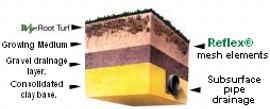
As SynTurf.org understands it, in Reliant Stadium the grass playing surface is on top of an StrathAyr drainage system. This consists of what the company calls an extremely resilient, safe and long lasting natural grass surface,” that has been proven at major racetracks and sports stadia around the world. “It consists of a specially engineered profile that incorporates a base drainage layer of gravel and pipes, a lower layer of sand and an upper rootzone layer reinforced with unique ReFlex mesh elements.” “The result is a natural grass surface which combines remarkable surface strength, excellent drainage and improved grass growth, allowing increased usage over a long period.” See, http://www.ecoterr.com/turftrack-grass-track-horse-racing/about_turftrack_grass_track_racing_systems.htm and http://www.ecoterr.com/turftrack-grass-track-horse-racing/grasstrack_racing_installations_around_the_the_world.htm.
Here is the clincher: The world famous Hong Kong Jockey Club pioneered the use of this system some 17 years ago. Other venues that use this all-weather drainage technology for grass tracks and fields are Kranji Racetrack in Singapore; Telsta and Parramatta stadia in Sydney, Australia; National Stadium Complex in Kuala Lumpur, Malaysia; Suncorp Stadium, Brisbane, Australia; and Urban Ventures in Minneapolis, Minnesota (USA).
But then perhaps the tyke and youth of America are more demanding of their grass fields than the jockeys and horses on the racetracks of Australia and Hong Kong.
Here is a thought, if we did not feed our kids like horses or insist that an offensive lineman needs to be really 300 pounds, may be there would not be as much wear and tear on the grass playing fields under their feet! Here is another idea. Why not tweak the rules of the game(s) for the sake of "going green" and help the natural grass fields last longer?
|
[No. 03] National Football League Field Trends. For a list of NFL's fields and grass/turf roster click here.
There are more natural grass fields in the NFL than artificial turf. In the last decade or so, there have been three conversions from artificial turf to natural grass (Chicago, Kansas City, San Francisco), which involved the old generation of artificial turf. The conversion by the New England Patriots from natural grass to artificial turf in December 2006 and the turf surfaces planned for the new Dallas Cowboys Stadium and Lucas Oil Stadium (Colts) would not suggest a trend toward natural grass. The Giant Stadium, on the other hand, is thinking of going back to natural grass (see MLS trends below at No. 02) and may give natural grass a slight advantage as far as trends may go. The synthetically enhanced grass technology (DD Grassmaster/Desso GrassMaster http://www.dessosports.com/en/home.html) and Prescription Athletic Turf drainage systems (http://www.themotzgroup.com/PAT/PAT_stats.php) may well help promote the retention or even new installation of natural grass in many venues, where the field use is limited to one or two sports. On the other hand the roll-in grass technology (such as in use at University of Phoenix Stadium/Arizona Cardinals) may allow for a natural grass surface that can be removed for other activities when needed. The trend in planning new venues is toward retractable roofs, which could promote the installation of natural grass because the roof can open to allow sunlight and rain and it can be closed to prevent flooding and other adverse climate conditions that can affect the field as well as spectator comfort. It is not necessarily inevitable that indoor venues that replace the old ones should have to have artificial turf surfaces.
|
[No. 02] Major League Soccer Field Trends. For a list of MLS's fields and grass/turf roster click here.
In the 2008 MLS season only 2 MLS venues will be artificial turf surfaces – BMO Filed in Toronto and Gillette Stadium (New England Revolution). Real Salt Lake and New York Red Bulls will be playing on natural grass: the assumption is that the conversion from playing on artificial turf will be achieved by the venues (Rice-Eccles Stadium and Giant Stadium, respectively) changing to natural grass. The trend toward natural grass in soccer is owed to two major factors -- the construction of smaller and dedicated soccer-specific venues and physical strains of playing soccer on artificial turf. The gain of net two natural grass fields in the 2008 season may be offset in 2010 if the newly franchised Philadelphia team opts for artificial turf.
|
|
The Delaware Riverkeeper Network [www.delawareriverkeeper.org] is an advocacy organization working throughout the Delaware River Watershed. As the voice of the River, the network champions the public interest with respect to the River and its streams. Assisted by professionals and a network of members, volunteers and supporters, the Riverkeeper seeks to restore the watershed's natural balance where it has been lost and ensuring its preservation where it still exists.
|
|