On This Page
Editor's Note : It is very fashionable to talk these days about a society’s carbon footprint and what each person or institution can do to reduce it. The artificial turf and other synthetic surfaces increase the carbon footprint and therefore contribute in their own way to greater global warming. Often the artificial turf replaces a natural grass surface, so one contribution by turf to global warming is the removal of the natural grass surface that reduces carbon dioxide by converting it into oxygen. The production process for artificial turf is for the most part fueled by fossil fuels, as is its installation, after-sale maintenance and eventual disposal protocols. The increased use of artificial fields by sports leagues promote greater concentration of vehicles at a site and thereby contributes to elevated presence of harmful gases in the area of the venue. The manufacturing, installation, service and disposal of a 2-acre artificial turf field facility is responsible for the generation of a total of 55.6 tons of carbon dioxide, in addition to other greenhouse gases and pollutants. The following items debunk the pernicious myth and misleading claims by the turf industry that artificial turf playing fields are a “green” alternative to grass!
|
[No. 07] Melbourne, Australia: A comprehensive database of research/publication on artificial turf’s carbon footprint (by John Englart - COP25 NGO observer for Climate Action Network Australia; Convenor of Climate Action Moreland; Member of Sustainable Fawkner, Victorian Climate Action Network). As part of a local campaign, Englart spent a considerable time between late 2020 and early 2021 researching synthetic turf in connection with plans to turn a grass sporting oval into a synthetic pitch in the northern suburbs of Melbourne. The full version of his research with an extensive annotated bibliography is published at
https://docs.google.com/document/d/1XyYAQwKdLI_ihDxSTDA8YvQ-z772AzvgVrTqZzECdTU/edit?usp=sharing . An earlier (slightly abridged) version was published on https://climateactionmoreland.org/2021/04/11/synthetic-turf-and-the-tragedy-of-the-commons-in-moreland/
One of the sections of Englart’s research is on carbon footprint of a synthetic turf soccer pitch. As he wrote to Synturf.org, “there have been two science based studies and one indicative study (with no methodology or full data transparency). He wrote a specific article on the emissions profile of synthetic on
https://climateactionmoreland.org/2021/02/28/natural-grass-or-synthetic-turf-what-are-the-total-life-cycle-emission-profiles/ .
Englart references the following sources:
- Eunomia Research & Consulting Ltd for FIFA, March 2017, Environmental Impact Study on Artificial Football Turf, https://football-technology.fifa.com/en/media-tiles/environmental-impact-study-on-artificial-football-turf/
- Meil, J., and L. Bushi, “Estimating the required global warming offsets to achieve a carbon neutral synthetic field Turf system installation: Athena Institute.” (2006). http://citeseerx.ist.psu.edu/viewdoc/summary?doi=10.1.1.562.9393
- Simon Magnusson and Josef Macsik, “Analysis of energy use and emissions of greenhouse gases, metals and organic substances from construction materials used for artificial turf”, Resourcces, Conservation and Recycling, (14 April 2017). https://doi.org/10.1016/j.resconrec.2017.03.007
A copy of the Magnusson and Macsik 2017 science article is reproduced here. “The most intriguing,” he wrote, “is the 2017 Eunomia Research & Consulting Ltd report done for FIFA which contains a graph of total life cycle emissions for synthetic turf for different infills and different end of life disposal with a kg/m scale. There is no methodology or data supporting this graph, but one assumes this is creditable as it was done for FIFA by a highly creditable consultancy.”
|
[No. 06] Life is better with sports in it – but at what cost? According to Gilbert Rist “Development consists of a set of practices, sometimes appearing to conflict with one another, which require - for the reproduction of society - the general transformation and destruction of the natural environment and of social relations. Its aim is to increase the production of commodities (goods and services) geared, by the way of exchange, to effective demand.” To quote Jonah Javad, another thinker of his time: “Sports is not life, but life is better with sports in it.” Put the to concepts together then you know what the following item grabbed out attention here at SynTurf.org.
David Thibodeau is a former competitive swimmer and a certified coach. He founded Sports for Social Impact to explore sport policy and provide insightful analysis to those working in the sport industry. He has a Masters in Public Policy and Administration from Carleton University. The following is an excerpt from his article “Sport and the environment” that was published on Sports and Development, 3 July 2020, at https://www.sportanddev.org/en/article/news/sport-and-environment :
… We need to recognize that the sports industry has an environmental footprint. Sports may be falling victim to climate change, but they are also part of the problem. All the flights of the athletes, coaching, mission staff and fans, building the venues, the energy consumed to run facilities, all the single-use plastics that will be handed out at events, and even the fireworks used during ceremonies. Everything has direct, and indirect impacts on the environment.
The UN Sports for Climate Action Framework states:
“Sports impact on our climate is complex and can be difficult to measure depending on the size of the organization and/or event. However, most sports organisations and fans would now acknowledge that sport’s contribution to climate change – through associated travel, energy use, construction, catering, and so on – is considerable. Moreover, sports’ global interest for billions of fans, and the media coverage generated in response, provide a strong platform for the sport sector to play an exemplary role in meeting the challenge of climate change, and inspire and engage large audiences to do the same.”
Everyone has a role to play when working towards fighting for climate change. Climate change will affect all sports from the elite, international levels to the grassroot, local levels in communities around the world, and disproportionately impact countries that are less developed….
… The IOC-Dow partnership helps the National Olympic Committee’s and International Federations measure and reduce their carbon footprints. This program will help IF’s and NOC’s that are implementing tangible action to tackle carbon emissions from their sport organisations and sporting events.
One thing happening is the use of synthetic grass produced from sugar cane-derived plastic that will be used to create the pitch for the field hockey tournaments in Tokyo 2020. The sugar cane that is used to produce the bio-polyethylene is a material that captures carbon dioxide. This is the kind of innovation that we need to be carbon negative in all aspects of our lives.
Tokyo 2020 has a goal of zero carbon and zero waste, using renewable energy to power the Games, eliminating edible parts of food waste, reducing packaging of materials, and their 2020 medal project where all medals are made from recycled materials.
Sport organisations need to move to a carbon negative, and eventually a carbon positive operating model. This means taking into account the facilities that are used by organisations. A National Sport Organisation or or International Sport Federation can implement policies that state they will only hold events that are held in facilities that are run by 100% renewable energy, policies that will lower food waste and single use plastics at events, and other policies that mitigate the impact of large (and small) sporting events on the environment.
… Many sports also have a lot of equipment that is made out of plastic (for example, swimming produces many silicon and latex swim caps, and when they break, they are tossed away.) Uniforms, and equipment are adding to waste production of teams and athletes around the world, making equipment that lasts longer, or that is recyclable is necessary. How can we upcycle these into new products? Can we make this equipment out of different materials? Sporting equipment also needs to be addressed in environmental policies.
Reconciliation with the environment means that we have to incorporate it into planning of sport events. The London 2012 Queen Elizabeth Olympic Park […] is a great example of an Olympic Park increasing the green space that is available for residents close by. Sport and the environment can work together, but we have to plan accordingly.
|
[No. 05] Sarah-Jeanne Royer on the adverse impact of artificial turf on the climate. Sarah-Jeanne Royer is Sarah-Jeanne Royer is a postdoctoral research fellow with the marine biology research division, Scripps Institution of Oceanography, University of California, San Diego. She has been a postdoctoral fellow at International Pacific Research Center, School of Ocean and Earth Science and Technology, at University of Hawaii. She received her PhD in Marine Sciences, cum laude, from the Institut de Ciències del Mar (CSIC), Barcelona, Spain, in 2015. She received a joint MSc in 2009 in International Ecology from University of Sherbrooke, Sherbrooke, Canada and Universidade Federal de Pernambuco, Recife, Brazil. She also holds an MSc in Biological Oceanography (2008) from her undergraduate alma mater Laval University, Québec, Canada. Among her more than a dozen refereed publication is with Jung, M.R., et al., Validation of ATR FT-IR to identify polymers of plastic marine debris, including those ingested by marine organisms, in Marine Pollution Bulletin 127, 704-716 (2018) - , doi:10.1016/j.marpolbul.2017.12.061. Her postdoctoral research interests has included oceanography and the influx of marine debris, plastic chemistry and photo-degradation, and biogeochemistry and ocean carbon and sulfur cycles. The following piece by Sarah-Jeanne Royer titled “Synthetic turf will contribute to greenhouse gas problems,” was published in Martha’s Vineyard Times (MV Times), 20 February 2018, at https://www.mvtimes.com/2019/02/20/synthetic-turf-will-contribute-greenhouse-gas-problems/ . We thank EHHI.org for bringing the piece to our attention.
I write as an oceanographer with expertise in plastic pollution to advise against the installation of synthetic turf on Martha’s Vineyard. My research has shown that the environmental health impacts posed by plastic carpets and polypropylene shock pads are likely significant, and should be at the forefront of any decision regarding these materials.
I am a postdoctoral researcher at the International Pacific Research Center at the University of Hawaii, focusing on the pathways and fate of marine debris and plastic pollution in the ocean. Prior to this position, I studied the emissions of greenhouse gases from plastics in the environment at the Center for Microbial Oceanography: Research and Education. I also recently started a project on microfibers at Scripps Institution of Oceanography at the University of California, San Diego, examining the degradability of plastic and microfibers in the environment. This past August, I was the lead author on a groundbreaking study, “Production of Methane and Ethylene from Plastic in the Environment,” in which we quantified greenhouse gas emission from plastics under natural conditions and considered the potential environmental consequences of this process.
We already knew that greenhouse gases are released during the manufacturing of products such as synthetic turf and shock pads, and now we have learned that greenhouse gases continue to be released while they are in use and as they degrade. Specifically, we found that the breakdown of plastic represents a significant source of greenhouse gas pollution that is expected to increase — especially as more plastic is produced and accumulated in the environment. Perhaps this is not surprising, since plastic is made from petroleum, but our team at the University of Hawaii was the first to publish data about greenhouse gases and plastic debris. The research has far-reaching implications for climate change, waste management, policymaking, and our decisions as consumers.
For my research, I looked at the most common types of plastic manufactured, consumed, and littered globally. Of particular concern is the plastic that releases gases at the highest rate: low-density polyethylene (LDPE). We showed that methane and ethylene offgassing is triggered by solar radiation, but continues in the dark, and likely over the lifetime of the plastic, accelerating exponentially as the surface area of the plastic increases due to weather and fragmentation. For example, LDPE powders offgas methane 488 times more than when the same weight of LDPE is in pellet form.
While carbon dioxide is perhaps the most well-known contributor to climate change, methane is a far more potent gas — shown to be at least 21 times more potent than carbon dioxide. Degrading plastic pollution is a source of climate change gas emissions not previously identified in the global greenhouse gas budget. If we consider globally the total surface of plastic exposed to solar radiation (in landfills, along coastlines, on playing fields, at playgrounds, in greenhouses, etc.), the problem of methane potency becomes magnified by the amount of plastic that exists worldwide. Ethylene, another greenhouse gas emitted from plastic, is produced in even greater amounts, and might contribute significantly to its budget.
Given that most plastic carpets are made out of polyethylene — the plastic found to release these gases at the highest rate — and given the high surface area occupied by this material, including each individual blade of plastic “grass,” synthetic turf likely contributes significantly to greenhouse gas emissions. I strongly urge you to consider how you can reduce these gases through policies restricting the installation of synthetic turf, as well as other synthetic surfaces, to guide consumers to make better choices and reduce plastic production everywhere we can.
Greenhouse gases directly influence climate change, increasing sea level rise, extreme weather events, heat waves, flooding, etc. As an island, Martha’s Vineyard is particularly vulnerable to these impacts. As a forward-thinking community known for its environmental stewardship and conservation efforts, Martha’s Vineyard is uniquely poised to be part of the solution regarding climate change. I applaud the Island’s efforts to ban plastic grocery bags, plastic straws, helium balloons, and now plastic bottles (all made with LPDE), and urge you to demonstrate that same leadership regarding synthetic turf.
|
 |
| The Lombardy poplar trees at |
|
[No. 04] Duncan, British Columbia (Canada): One More Act Of Cruelty Against Nature—Making Way For Synthetic Turf Fields! SynTurf.org, Newton, Mass. 1 March 2015. According to a news article in the Santa Cruz Sentinel (14 April 2010), a report from the University of California at Berkeley concluded that significant greenhouse gases are released in … creation [of artificial turf fields].” Genevieve Bookwalter, “New study provides fuel for both sides of artificial turf fight,” in Santa Cruz Sentinel, 14 April 2010, available at http://www.santacruzsentinel.com/localnews/ci_14879819 . The pdf version of this article is available via http://www.synturf.org/carbonfootprint.html (Item No. 03).
The report concluded that “[a]rtificial turf releases more greenhouse gases in its production, transportation and processing than the maintenance of natural turf ever would.” The report also stated that “[n]atural grass requires fertilizer, which could contaminate water supplies, and regular mowing, the emissions of which contribute to greenhouse gases. It also requires watering, which could tax a limited supply.” The report however made no mention of the existence of natural grass technologies that address each of the grass-is-bad arguments: organic and natural occurring fertilizers as opposed to chemicals; integrated pest management systems, grass that requires less water and shorter growing season, with deeper root systems and shorter blades.
As for the artificial turf itself: A well-groomed and maintained artificial turf field requires watering (to keep silica dust down, smooth the playing surface, cool down); it requires also antibacterial treatments, pesticides, fungicides, and herbicides. While the installation, mowing (grass)/grooming (artificial turf) and lighting and watering (irrigation) all require some greenhouse gas emissions, in terms of carbon footprint the report did say this: “Artificial turf releases more greenhouse gases in its the production, transportation and processing than the maintenance of natural turf ever would.”
In 2006, Upper Canada College, a private elementary and secondary school in Toronto, Canada, decided to replace its natural grass playing field with a new state-of-the-art, artificial turf surface. A study conducted by the Athena Institute, Merrickville, Ontario, compared the estimated greenhouse gases (GHG) emitted during the life cycle of the synthetic turf system with a natural grass surface. The study looked also at the number of trees that have to be planted in order to achieve a 10-year carbon neutral synthetic turf installation. For a 9,000 square-meter facility, the research showed a total CO2 emission of 55.6 tons. The Athena study estimated that 1861 trees needed to be planted in order to achieve a 10-year carbon neutral synthetic turf installation. See Jamie Meil and Lindita Bush, Estimating the Required Global Warming Offsets to Achieve a Carbon Neutral Synthetic Field Turf System Installation, available at http://www.athenasmi.ca/projects/recentProjects.html or accessible via http://www.synturf.org/carbonfootprint.html (Item No. 01).
Unlike the environmentally unsustainable artificial turf, a natural grass field acts to reduce carbon dioxide (CO2). A 2008 research found that “[a]fter reviewing the direct carbon sequestration of grasses and their root systems, … managed lawns sequester, or store, significant amounts of carbon, capturing four times more carbon from the air than is produced by the engine of today’s typical lawnmower.” The study also found that “wellmanaged turfgrasses that are cut regularly and at the appropriate height, fed with nutrients left by grass clippings, watered in a responsible way, and not disturbed at the root zone actively pull pollutants from the air, creating a greater carbon benefit.” See Ranajit Sahu, Technical Assessment of the Ccarbon Sequestration Potential of Managed Turfgrass in the United States (2008). Dr. Sahu holds a masters and doctoral degrees in mechanical engineering from California Institute of Technology at Loyola Marymount University (Los Angeles, California) he teaches courses in air pollution and environmental health risk assessment. The report can be accessed via http://www.synturf.org/carbonfootprint.html (Item No. 02).
Much of the foregoing was all known—or should have been known—to policymakers and politicians in Concord, Massachusetts, when in 2007 they decided to clear acres upon acres of the historic Walden Woods in order to make room for synthetic turf fields. See National Public Radio (Shannon Mullen), “Soccer Fields Latest Threat to Thoreau’s Woods,” on 16 April 2007, at http://www.npr.org/templates/story/story.php?storyId=9598763 . Not exactly a tribute to the legacy of the naturalist David Henry Thoreau of the On the Walden Pond fame.
If the San Francisco politicians and their misguided monied backers to have the ultimate say, by next year, acres upon acres of the natural grass playing fields at Beach Chalet on the national historic Golden Gate Park will be turned into synthetic fields topped with carcinogen-packed crumb rubber infill. See the posts at http://www.synturf.org/sanfranciscobrief.html . Not exactly a tribute to the legacy of the birthplace of the environmental movement.
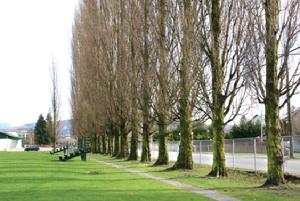
Now comes news of another impending unspeakable cruelty against nature—this from North Cowichan, in Duncan, British Columbia. According to a news report in Cowichan Valley Citizen (13 February 2015), “[t]he Lombardy poplar trees that have so long been a part of the local scene beside the David Williams field at the Sherman Road soccer park are coming down. North Cowichan council approved the move Feb. 3 [2015]….The trees were assessed by an expert, who said they need to come down. Council had, at its July 16 [2014] meeting, approved the construction of a synthetic turf field at [the park].” The following is a constructed give-and-take among/between the players in this tragic story:
- Ernie Masueti (NC North parks and recreation director): - The trees were planted in 1969. Some of the poplars have already been removed due to failing health. The tree roots extend into the field, road and drainage systems, which negatively affect the infrastructure. The installation of the synthetic turf will require excavation, which will result in root damage to the trees. Another problem is that, due to their height, the trees do not allow adequate sunlight to defrost the field quickly and therefore have made it unplayable during the winter season.
- Joyce Behnsen (Councillor): Masueti and [David] Polster (Cowichan Valley Naturalists) are working together to address the problem roots of any new trees may pose to the installation of the artificial turf.
- Rob Douglas (Councillor): Mr. Mansueti, I’m assuming these trees have quite deep root structures and if we tear them out, I’m just wondering if there are going to be any drainage issues as a result?
- Masueti: There shouldn’t be. We cut the roots right then and there and then take them down to the stumps and then grind the stumps. They’e actually caused more problems because they take so much water up through the heat of the summer. They affect the field that way.
- Kate Marsh (Councillor): Although I might often be called a treehugger, I have complete confidence in Polster’s assessment and Mansueti’s plan.
- Maeve Maguire (Councillor): Is there any value in the wood?
- Masueti: There’s probably value in it for someone. Poplars don’t burn, even for firewood. But, if there’s a value to them and someone would like them, that would be great.
Source: Lexi Bainas, “Poplar trees at North Cowichan field must come down,” in Cowichan Valley Citizen, 13 February 2015, at http://www.cowichanvalleycitizen.com/news/poplar-trees-at-north-cowichan-field-must-come-down-1.1761997
SynTurf.org Note: The foregoing reminds one of a passage in Act I of Robert Bolt’s brilliant 1960 play A Man for All Seasons. A character named Roper announces his readiness to “cut down every law” in order to achieve his purpose—similar to the call by Masueti and Company to cut down every poplar. Sir Thomas More says to Roper, “The currents and eddies of right and wrong, which you find such plain sailing, I can’t navigate. I’m no voyager. But in the thickets of the law, oh, there I’m a forester. I doubt if there’s a man alive who could follow me there, thank God…And when the last law was down, and the Devil turned round on you-where would you hide, Roper, the laws all being flat? This country’s planted thick with laws from coast to coast-man's laws, not God's-and if you cut them down-and you're just the man to do it-d’you really think you could stand upright in the winds that would blow then?"
|
[No. 03] Berkeley Report: Artificial turf releases more greenhouse gases in its production, transportation and processing than the maintenance of natural turf ever would.” SynTurf.org, Newton. Mass. April 25, 2010. According to a news article in the Santa Cruz Sentinel (April 14, 2010), a recently released report from University of California at Berkeley “concludes that player injuries drop on artificial turf but significant greenhouse gases are released in its creation.” See Genevieve Bookwalter, “New study provides fuel for both sides of artificial turf fight,” in Santa Cruz Sentinel, April 14, 2010, available at http://www.santacruzsentinel.com/localnews/ci_14879819 or click here for pdf.
While the first conclusion may not be necessarily a valid one (see http://www.synturf.org/health.html ), the second conclusion about the carbon footprint of artificial turf fields is on the money (see http://www.synturf.org/carbonfootprint.html ).
The Sentinel quoted David Dornfeld, a Berkeley professor and director of the school's Laboratory for Manufacturing and Sustainability, as saying the report was compiled “to make sure that the resources that were referred to were reasonable.”
The report concluded that “Artificial turf releases more greenhouse gases in its the production, transportation and processing than the maintenance of natural turf ever would.”
As far as SynTurf.org is concerned, this alone is the most significant conclusion of the report, considering that the report is entitled Review of the Impacts of Crumb Rubber in Artificial Turf Applications (February 2010) and “was commissioned by The Corporation for Manufacturing Excellence [MANEX], an industry consulting firm. That company has, in the past, worked with California Integrated Waste Management Board to find ways to best recycle old tires. Those tire pieces often turn into the newest artificial playing fields.” According to Manex’s website http://www.manexconsulting.com/?PageID=268 , individuals interested in obtaining a copy of the full report may email turfstudy@manexconsulting.com .
With the exception of the report’s admission that “Artificial turf can become hot and uncomfortable to play on in warmer months,” which is a no-brainer (see http://www.synturf.org/heateffect.html ), the report’s other conclusions at best perpetuate the myths that the turf industry and proponents of the product have been foisting on the public and way-too-eager politicians and decision-makers.
To illustrate: The conclusion that “The cost to own and maintain artificial turf fields over a decade is 10 to 20 percent less than the cost of natural grass fields” has long been challenged as yet another myth. See http://www.synturf.org/wrapuparticles.html item No. 8 and items relative to maintenance/replacement at http://www.synturf.org/maintenancereplacement.html .
The report also concluded that “artificial turf contains elements that could be toxic to humans,” but dismissed the finding by stating that “ordinary use does not expose players to levels considered dangerous.” The mounting evidence based on research by the scientific and medical communities suggests that a statement such as this conclusion is simply irresponsible, considering that some of the effects of the substances of concern are cumulative. See the various items reported and posted under http://www.synturf.org/warnings.html and http://www.synturf.org/crumbrubber.html and http://www.synturf.org/phthalates.html and http://www.synturf.org/ehhibrief.html and http://www.synturf.org/silica.html and http://www.synturf.org/lead.html and http://www.synturf.org/wrapuparticles.html .
Without the benefit of a conscientious and peer-reviewed longitudinal health study there is no telling what the long-term effect of exposure to chemicals of concern would be on children and youth end-users of turf fields. What we do know is that some of these chemicals and substances have a proven record of being unhealthy at best, carcinogenic and fatally toxic in some other cases to living organisms.
Perhaps the most telling of the general ignorance of the Berkeley report is this statement: “Natural grass requires fertilizer, which could contaminate water supplies, and regular mowing, the emissions of which contribute to greenhouse gases. It also requires watering, which could tax a limited supply.” There are natural grass technologies out there that address each of the grass-is-bad arguments: organic and natural occurring fertilizers as opposed to chemicals; integrated pest management systems, grass that require less water and less growing seasons, with deeper root systems and shorter blades. As for the artificial turf itself: A well-groomed and maintained artificial turf field requires watering (keep silica dust down, smooth the playing surface, cool down); it requires antibacterial treatments, pesticides and fungicides and herbicides, too.
While the installation, mowing (grass)/grooming (artificial turf) and lighting and watering (irrigation) all require some greenhouse gas emissions, in terms of carbon footprint the report did say this: “Artificial turf releases more greenhouse gases in its the production, transportation and processing than the maintenance of natural turf ever would.” Emphasis added.
|
[No. 02] Natural grass to the rescue! A recent study concludes: Even with all of the carbon footprint talk associated with the installation and maintenance of natural grass fields, the managed turf grass is still a viable foot soldier in combating the environmental challenges of global climate change. “After reviewing the direct carbon sequestration of grasses and their root systems, we found that managed lawns sequester, or store, significant amounts of carbon, capturing four times more carbon from the air than is produced by the engine of today’s typical lawnmower. The study also finds that well-managed turfgrasses that are cut regularly and at the appropriate height, fed with nutrients left by grass clippings, watered in a responsible way, and not disturbed at the root zone actively pull pollutants from the air, creating a greater carbon benefit.’ On this and other interesting findings, see Ranajit Sahu, Technical Assessment of the Ccarbon Sequestration Potential of Managed Turfgrass in the United States (2008). The research report is available here. Dr. Sahu holds a masters and doctoral degrees in mechanical engineering from California Institute of Technology. At Loyola Marymount University (Los Angeles, California) he teaches courses in air pollution and environmental health risk assessment.
|
No. 01] Estimating the Required Global Warming Offsets to Achieve a Carbon Neutral Synthetic Field Turf System Installation, by Jamie Meil and Lindita Bush. Link to PDF file http://www.athenasmi.ca/projects/recentProjects.html. In 2006, Upper Canada College, a private elementary and secondary school in Toronto, Canada decided to replace its natural grass playing field with a new state-of-the-art, artificial turf surface. A study conducted by the Athena Institute, Merrickville, Ontario, estimated the greenhouse gases (GHG) emitted during the life cycle of the synthetic turf system as opposed to a natural grass surface. The study also determined the number of trees to be planted to achieve a 10-year carbon neutral synthetic turf installation.
For a 9,000 square-meter facility a 10-year period, the research showed a total CO2 emission of 55.6 tons. An Amercian football field (53.3 yards wide times 100 yards long minimum, without end zones and sidelines) is larger than an acre; and acre is equal to 4,047 square meters or 4,840 square yards. The GHG emissions offset was estimated at -72.6 tons. According to the U.S. Department of Energy estimate (1998), a medium growth coniferous tree, planted in an urban setting and allowed to grow for 10 years, sequesters 23.2 lbs of carbon, equivalent to 0.039 metric ton CO2. The tree planting offset requirements to achieve a 10-year carbon neutral synthetic turf installation was estimated to be 1861 trees.
An environmental responsible organization, UCC took the initiative to offset the GHG emissions related to the synthetic turf life cycle -- from raw material acquisition through manufacturing, transportation, use and maintenance, and end-of-life disposal of the turf field. To that end, UCC will plant trees in order to balance the field’s carbon footprint, and reuse all the topsoil that is removed during construction. In taking on the challenge of sustainability, UCC has moved to install a “carbon neutral” artificial turf field on its campus.
|
|