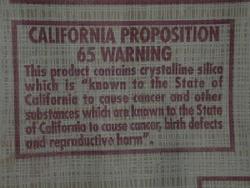
In June 2008, SynTurf.org carried a news story in which Washington DC activists and officials were calling attention to the potential harm from the silica sand used in artificial turf fields. Sand is often a part of the sub-base and it is used with crumb rubber granules in the mix that is called “infill,” which is applied topically to the surface of the turf field. For details on the DC story, go to http://www.synturf.org/warnings.html (Item No.20). Previously, SynTurf.org also had called attention to dangers of silica sand by reproducing the text of the warning panel from an empty bag of silica sand that was used on Tufts University’s artificial turf field in Medford, Mass. See http://www.synturf.org/industrynotes.html (Item No. 02).
This page is dedicated to information about silica sand, as used in artificial turf fields. It is appropriate that the first item under this banner be U.S. Environmental Protection Agency's own assessment of health risks associated with crystalline silica.
Please beware: Were you ever to raise silica as an issue when opposing artificial turf fields, the industry reps and community promoters of turf fields will ridicule you by implying that we should all stay away from sandboxes and beaches! Keep your cool, and remind them that inhalation of particulate matter, just as exposure to the sun’s harmful rays tend to pose health risks for all ages.
|
[No. 4] How dangerous is silica on artificial turf fields? A few days ago we received an item from our friends at the Environment and Human Health, Inc. (www.ehhi.com) about the use of silica in fracking operations in order to crack the shale and get to the natural gas. Fracking companies are expected to use 56.3 billion pounds of sand this year, blasting it down oil and natural gas wells to help crack rocks and allow fuel to flow out. According to EHHI this presents a serious health threat to workers and all those who are exposed to the silica. We agree and would like to add also that silica is used in artificial turf fields and that its adverse impact on player’s health must be looked at by health professionals and institutions.
Wheeling, West Virginia: The health risk of silica. According to a news report in The Intelligencer: Wheeling News-Register (10 April 2014), “Breathing only a tiny amount of silica dust per day - enough, roughly, to cover Franklin Delano Roosevelt’s nose on a dime - can put a worker at risk for myriad health problems, according to Michael Breitenstein of the National Institute for Occupational Safety and Health.
Research by his agency, part of the Centers for Disease Control and Prevention, shows many workers at natural gas wells where hydraulic fracturing, or fracking, takes place are being exposed to the substance in much higher quantities. And according to West Virginia University professor Michael McCawley, the Northern Panhandle of West Virginia and southwestern Pennsylvania - at the heart of Marcellus Shale gas development - are seeing some of the nation’s highest rates of mortality due to silicosis, a disease that hardens the lungs through inflammation and development of scar tissue.”
“Breitenstein’s and McCawley’s presentations were part of a panel discussion on silica exposure at the West Virginia Oil and Natural Gas Association's inaugural ShaleSafe Conference and Expo at Oglebay Park in Wheeling.”
“In addition to silicosis, overexposure can lead to lung cancer, kidney problems and autoimmune problems such as lupus and rheumatoid arthritis. Although typically identified as a hazard of the construction industry, silica’s effect on natural gas workers has drawn much attention recently, and the federal Occupational Safety and Health Administration is in the process of developing new limits on worker exposure to the substance for the first time in more than 40 years.”
“It’s not clear when OSHA will make a decision on the proposed new rule, which would set a permissible exposure limit of 50 micrograms per cubic meter for silica averaged over an eight-hour period and prevent about 1,600 new cases of silicosis per year, the agency estimates. According to John Keeling of MSES Consultants Inc. of Clarksburg, OSHA's current standard is based on a complicated formula. ‘The fact that you don’t see anything in the air doesn’t mean that there’s not a problem,’ Keeling said.” Source: Ian Hicks, “Gas Workers Risk Silica Exposure,” in The Intelligencer: Wheeling News-Register, 10 April 2014, at http://www.news-register.net/page/content.detail/id/598589/Gas-Workers-at-Risk-Of-Silica-Ex---.html
|
[No. 3] Silica: The hidden danger in artificial turf fields. The paucity of items regarding the dangers of silica in artificial turf fields is arguably evidence of the general ignoring of the danger by politicians and purveyors of artificial turf fields on the an intellectually dishonest statement that sand in artificial turf fields is no more dangerous than going to the beach. Would be not go to the beach for fear of inhaling sand dust? The jury may well be out on the issue of harms from fine sand dust among beach volleyball players, either full blown silicosis or chronic pulmonary harms due to inhalation of particulates. The harm caused by the sand dust used in artificial turf fields is well documented and subject of industry warning labels. See items on this page.
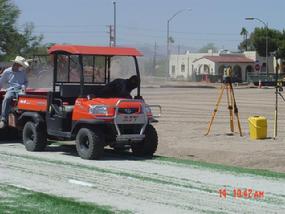
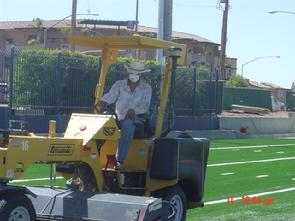
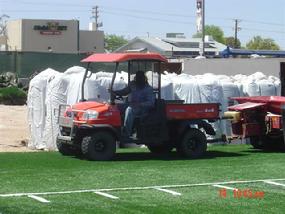
The following pictures were taken by one of our readers on May 14, 2010, during a visit to the University of Arizona, where crews were expanding the artificial turf practice field. Please notice the workers wearing respiratory masks. They are spreading the silica sand first and then the crumb rubber and sweeping it into the fake grass. Now ask yourself, should a child or even a grown up wear a mask when playing on turf fields for fear of inhaling sand dust particulate?
|
[No. 2] Silica sand: Playing in sandbox [and on artificial turf field] not a day at the beach! According to a news report in the Richmond-Times Dispatch (July 31, 2009), “Cindy Bennett’s only initial concern with the sandbox in her son’s first outdoor play set was the mess it would create. She never thought the threat of cancer would be the issue.” Crystalline silica dust from the engineered sand, considered a lung hazard, is regulated by the Occupational Safety and Health Administration in industrial settings. It’s recognized as a carcinogen by the Environmental Protection Agency.” “Not really what I want my little guy playing in and throwing in the air,” Bennett said. “Quikrete and other brands marketed as play sand contain not only crystalline silica but traces of the mineral tremolite, a form of asbestos. For those reasons, California requires a warning label -- part of the state's Proposition 65 governing hazardous substances -- on play-sand bags. The label states that the product contains chemicals known to cause cancer, birth defects and reproductive harm.” “Quikrete recommends that consumers dampen the sand to minimize the possibility of ambient silica in the air.” “The idea of keeping it moist is ridiculous,” said Katy Farber, author and founder of [Non-ToxicKids.net], “Kids are going to be pouring it or playing in it on dry summer days. You can see the dust in the air as it’s being poured. It’s easily ingestible.” Source: Julie Young, “Toxicity of play sand worries parents,” in Richmond Times-Dispatch, July 31, 2009, available at http://www2.timesdispatch.com/rtd/lifestyles/home_garden/article/H-SAND31_20090730-185807/283133/ .
SynTurf.org Note: This [sand silica] is the same material that is mixed in tons with crumb rubber and applied on top of the artificial turf fields. Query: What kind of “sand” is used in the substrate of the artificial carpet?
|
[No. 01] EPA’s view on crystalline silica. The EPA’s longstanding view of crystalline silica is contained in a document entitled, Health Effects of Inhaled Crystalline and Amorphous Silica, EPA/600/R-95/115, 1996. It is available at here or at the EPA’s website at http://oaspub.epa.gov/eims/eimsapi.dispdetail?deid=12999. The study’s abstract states, “Recently, public concern regarding nonoccupational or ambient silica exposure, mainly to crystalline silica, has emerged making it important to evaluate background and ambient concentrations. Ambient emissions of silica rarely are estimated or measured in air pollution studies of particulate matter. Crystalline silica is widely used in industry and has long been recognized as a major occupational hazard, causing disability and deaths among workers in several industries. This is a health risk assessment covering the causes and studies of crystalline silica exposure.” For further information on this subject, contact the EPA ( www.epa.gov ) at ncea.webmaster@epamail.epa.gov .
|
|